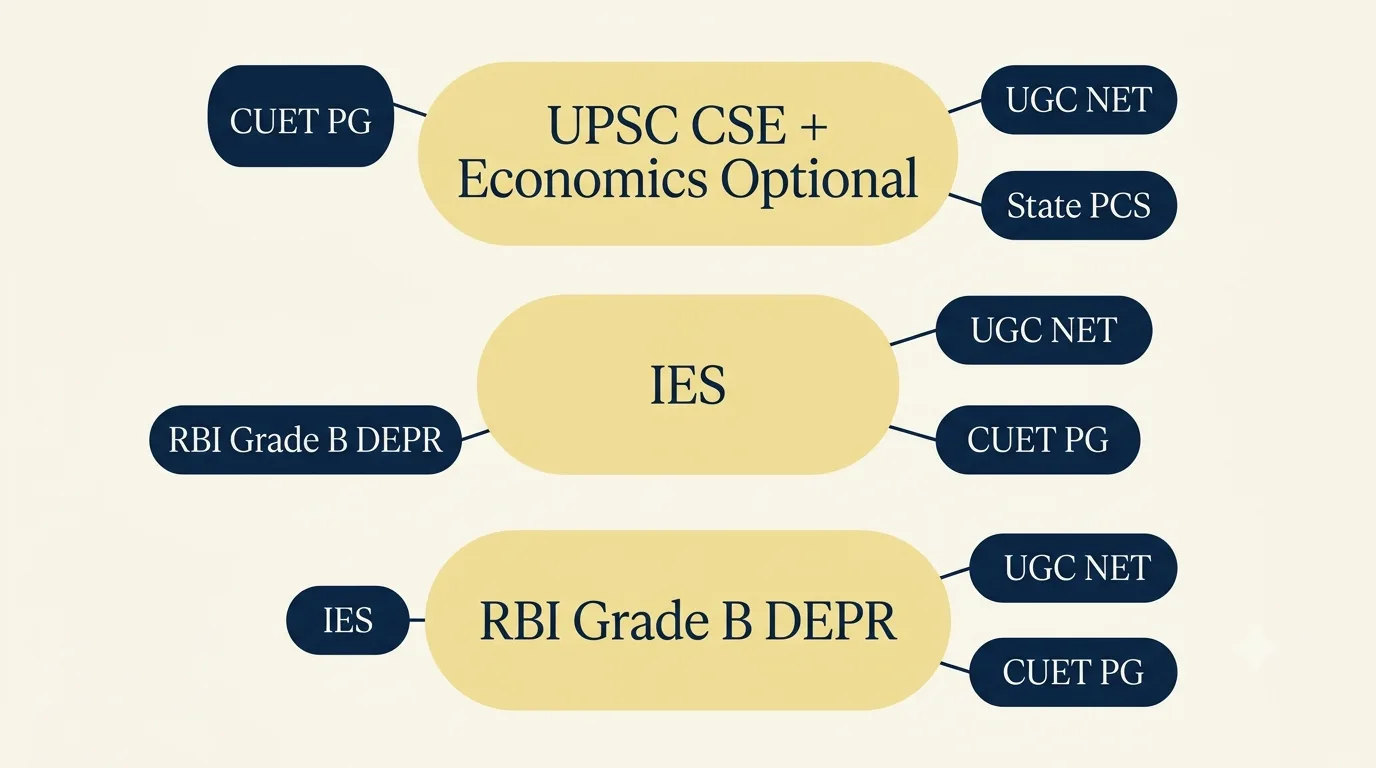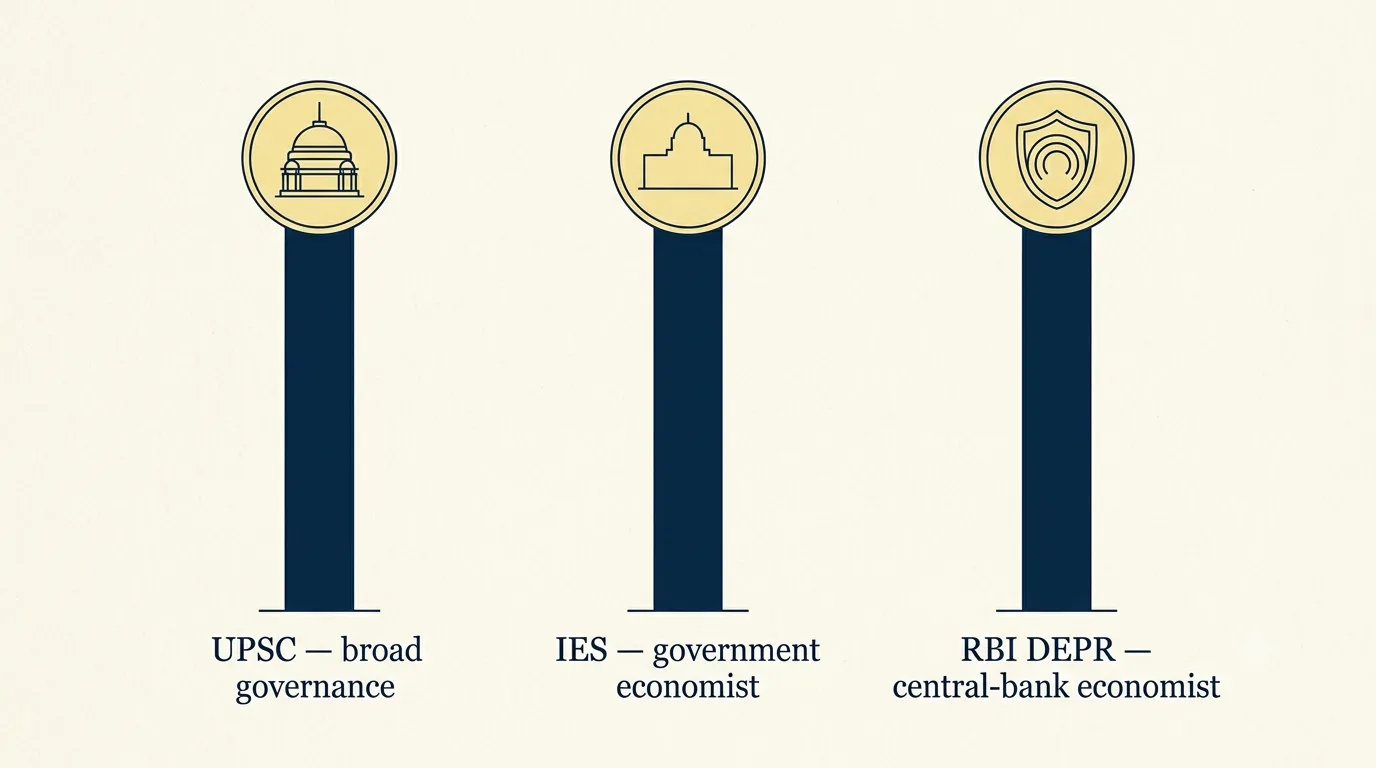
For four straight posts in this series, we went deep into three specialist exams — UPSC CSE Economics Optional, the Indian Economic Service, and RBI Grade B DEPR. They are the peak of the government path for an Economics student. They are not the whole path.
A lot of students believe that if you are not writing one of those three, the government option is closed. That is not true. Below that peak sits a much wider range of exams — some financial, some regulatory, some banking, some generalist — where an Economics degree is not a formal requirement but is a real, quiet advantage. This post lays out that map.
First — one thing to be clear about
Two ideas hold across everything that follows.
- Economics graduates are eligible for every general government exam. SBI PO, SSC CGL, State PCS, RRB NTPC — none of them ask for an Economics degree. If you have a graduation, you qualify.
- Even where Economics is not tested, it is still an edge. Quantitative aptitude, current affairs, basic macroeconomic reasoning — banking, insurance and generalist exams test all of these. If you have spent three or five years in an Economics classroom, you have been preparing for them without knowing it.
Keep both of these in mind. They are why the exams below are worth writing seriously, not just as a backup to the specialist three.
The four clusters
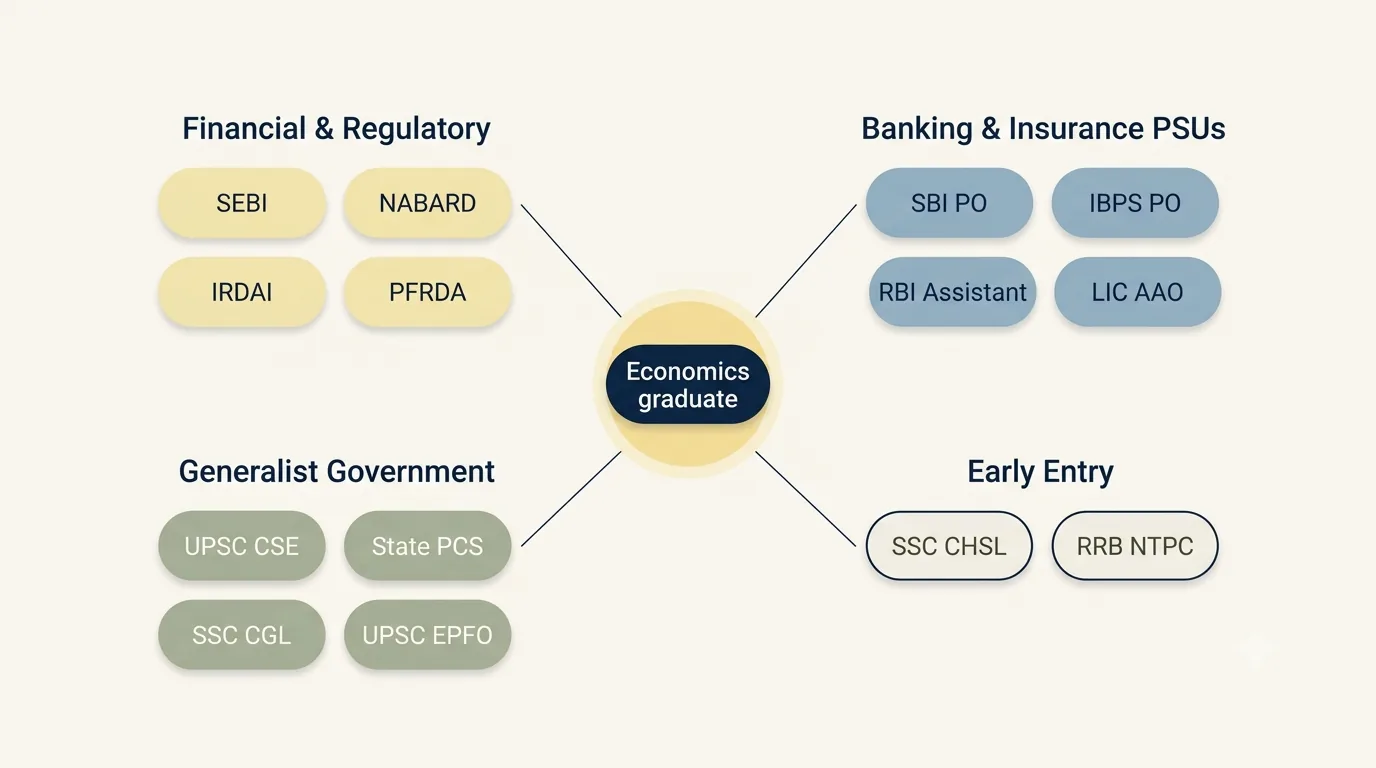
I have organised the map into four clusters based on how specialised the work is, how much Economics helps, and how quickly you can enter.
Swipe sideways to see all columns.
| Cluster | Representative exams | Economics-heavy? | Minimum degree |
|---|---|---|---|
| 1. Financial and regulatory bodies | SEBI Grade A, NABARD Grade A, PFRDA, IRDAI, IFSCA, SIDBI, EXIM Bank, ECGC | Meaningfully, especially in research and development-finance streams | Graduation for most; MA preferred for specialist streams |
| 2. Banking and insurance PSUs | SBI PO, IBPS PO, IBPS Clerk, RBI Assistant, LIC AAO, NIACL AO | Not directly, but Economics is a real skill edge | Graduation |
| 3. Generalist government track | UPSC CSE (without Economics optional), State PCS, SSC CGL, UPSC EPFO | Not directly; supports GS Economy | Graduation |
| 4. Early entry, still in college | SSC CHSL, RRB NTPC | Not directly | Class 12 / graduation |
The clusters shade into each other at the edges — RBI Assistant is a banking PSU but sits inside RBI; UPSC EPFO is a UPSC exam but tests specialised subjects. Take the table as a map, not a boundary.
1. Financial and regulatory bodies
The financial-sector regulators and development-finance institutions — the Securities and Exchange Board of India (SEBI), the National Bank for Agriculture and Rural Development (NABARD), the Pension Fund Regulatory and Development Authority (PFRDA), the Insurance Regulatory and Development Authority of India (IRDAI), the International Financial Services Centres Authority (IFSCA), the Small Industries Development Bank of India (SIDBI), the Export-Import Bank of India (EXIM Bank), and the Export Credit Guarantee Corporation (ECGC).
This is not RBI Grade B DEPR level specialisation, but the work is genuinely finance and policy adjacent. An Economics or Finance background helps directly in the research and development-finance streams — the SEBI Grade A Research stream and the NABARD Grade A RDBS (Rural Development Banking Service) posting are the clearest examples.
To put it in scale: the SEBI Grade A 2025 notification announced 110 Assistant Manager vacancies across streams, including 4 in the Research stream. The NABARD Grade A 2025 notification announced 91 Assistant Manager vacancies, with 85 in the RDBS stream. Small seats, focused pool — the same shape as the specialist exams higher up.
2. Banking and insurance PSUs
The State Bank of India Probationary Officer (SBI PO), the Institute of Banking Personnel Selection Probationary Officer (IBPS PO), IBPS Clerk, the Reserve Bank of India Assistant, the Life Insurance Corporation Assistant Administrative Officer (LIC AAO), and the New India Assurance Company Limited Administrative Officer (NIACL AO).
Economics is not part of the syllabus. Any graduate can appear. But the syllabus itself — quantitative aptitude, reasoning, English, general awareness with a banking bias — is exactly the toolkit an Economics degree builds anyway. And the scale here is large: the IBPS PO 2025 notification (CRP-XV) opened 5,208 vacancies across 11 participating public sector banks; the SBI PO 2025 notification announced 541 vacancies. If you are willing to write consistently, the odds are meaningfully better than the specialist peaks.
3. Generalist government track
The UPSC Civil Services Examination (without Economics as the optional), the State Public Service Commissions, the Staff Selection Commission Combined Graduate Level (SSC CGL), and UPSC Employees’ Provident Fund Organisation (EPFO) — Enforcement Officer / Accounts Officer and Assistant Provident Fund Commissioner recruitment.
Economics is not compulsory here either. But if the UPSC structure appeals to you — administration, governance, public service — and you do not want to build a Mains-level depth in Economics as an optional, this route is entirely valid. Your Economics background continues to help in the General Studies Economy paper.
Scale is generous. SSC CGL 2025 was notified with 15,130 final vacancies across Group B and Group C posts. The UPSC EPFO 2025 recruitment announced 230 posts — 156 EO/AO and 74 APFC. Both are structurally more open than UPSC CSE.
4. Early entry, still in college
The Staff Selection Commission Combined Higher Secondary Level (SSC CHSL) and the Railway Recruitment Board Non-Technical Popular Categories (RRB NTPC) are undergraduate-level exams.
If you are in the middle of a bachelor’s degree and want to start earning early — without waiting for a master’s or a multi-year preparation cycle — this cluster is for you. The work is clerical and administrative in most postings, but the entry is faster and the schedule is predictable.
The one common thread
Notice what runs across all four clusters. Economics gives you a slight edge everywhere, even when the subject itself is not tested. Quantitative comfort, the habit of following current affairs closely, and macroeconomic reasoning are all transferable — and they are exactly what banking, insurance and generalist exams measure.
You will not get credit for your degree on the answer key. But you will walk into the exam hall better prepared than most of the room.
Applying the four-question framework
The same four questions from Post 1 apply here, with a slightly different weighting.
1. Time horizon. Early-entry exams (SSC CHSL, RRB NTPC) and banking PSUs (SBI PO, IBPS PO) have the fastest cycle-to-appointment timelines. Financial-regulator exams and UPSC CSE take longer.
2. Risk tolerance. Banking PSUs and SSC CGL have larger seat counts and predictable calendars — lower variance than the specialist exams. Financial regulators have small seats, but the pool is smaller and better-defined too.
3. Interest. Financial regulators are the closest to real economic work in this map. Banking PSUs are more operational than analytical. Generalist services are about governance and administration, not Economics. Choose honestly.
4. Job suitability. This is where the specialist / generalist choice really shows up. If your natural fit is analytical, reading-heavy work, lean into the financial regulator cluster. If you prefer high-tempo, public-facing operational work, generalist services and banking PSUs suit better.
One caveat that holds across the whole map: eligibility, vacancies and exam patterns change every notification cycle. This post is a structured map, not the final word. Always check the official notification before applying.
Takeaway. UPSC CSE, IES and RBI DEPR are the peak of the government path for an Economics student — but the map below them is wide. Four clusters, roughly twenty exams, and in every one of them your Economics degree is a quiet advantage. Choose the cluster that matches your time horizon and temperament. Then commit to one primary; do not spread across all four.
Sources and further reading
- Securities and Exchange Board of India — sebi.gov.in: official Grade A notifications, current-cycle vacancies and syllabus.
- National Bank for Agriculture and Rural Development — nabard.org: official Grade A notifications and eligibility.
- Institute of Banking Personnel Selection — ibps.in: CRP-PO / MT and CRP-Clerks notifications for participating public sector banks.
- State Bank of India, Careers — sbi.co.in/web/careers: SBI PO and specialist officer notifications.
- Staff Selection Commission — ssc.gov.in: CGL, CHSL and other combined recruitment notifications.
- Union Public Service Commission — upsc.gov.in: CSE and EPFO Enforcement Officer / APFC notifications.
- Reserve Bank of India, Opportunities — opportunities.rbi.org.in: RBI Assistant and Grade B notifications.
- Life Insurance Corporation, Careers — licindia.in/careers: LIC AAO notifications.
- Railway Recruitment Board — rrbcdg.gov.in: RRB NTPC and other centralised notifications.
On EcoNiti
- Careers in Economics: the framework — the five broad paths and the four decision questions the whole series returns to.
- UPSC vs IES vs RBI Grade B DEPR — the three specialist exams that sit above this map.
- The backup cluster strategy — how to pair a primary exam with a small, syllabus-aligned backup cluster instead of writing everything you are eligible for.
- Beyond government: higher studies, corporate, academia and alternatives — the series finale, covering the four non-government paths.
Questions students ask
Do I have to write UPSC CSE, IES or RBI Grade B DEPR to get a serious government job as an Economics graduate?
No. UPSC CSE, IES and RBI DEPR are the specialist and prestige peaks, but there are four other clusters — financial regulators (SEBI, NABARD, PFRDA, IRDAI, IFSCA, SIDBI, EXIM, ECGC), banking and insurance PSUs (SBI PO, IBPS PO, IBPS Clerk, RBI Assistant, LIC AAO, NIACL AO), the generalist track (UPSC CSE without Economics optional, State PCS, SSC CGL, UPSC EPFO) and undergraduate-level early-entry exams (SSC CHSL, RRB NTPC). Any Economics graduate can write them, and the degree gives a quiet but real edge.
Is Economics actually useful in these exams if it is not part of the syllabus?
Yes. Quantitative aptitude, current affairs and basic macro reasoning are already part of an Economics degree. Banking, insurance and generalist exams test exactly those skills. You do not get credit for the degree on paper, but you enter the exam better prepared than the average candidate.
Which of these exams is right for a BA Economics student in the final year?
If you want to start earning early, SSC CHSL and RRB NTPC are undergraduate-level exams. If you can wait one more cycle, SBI PO, IBPS PO and IBPS Clerk open up after graduation. SSC CGL is available immediately after graduation. Specialist financial-regulator exams like SEBI Grade A become more attractive once you finish an MA, because most vacancies favour a postgraduate profile.