The UPSC Civil Services Mains has nine papers. Two of them — Paper VI and Paper VII — are your optional subject. Each carries 250 marks; together, 500 marks. Out of the 1750 marks that decide your Mains merit list, your optional is worth close to 29% (500 / 1750). Candidates with identical GS scores routinely finish 100–200 ranks apart because of their optional performance.
So this is not a minor decision. And if you have an Economics background, the specific question you are stuck on is: should Economics be my optional?
This post lays out the case for. The honest concerns, the three-question decision test and the four preparation principles are in the next post — read that before you commit.
Already decided on Economics? See the Economics Optional syllabus and exam guide. If you are comparing classes, the UPSC Economics Optional coaching page explains the teaching, fees, tests and support from Dr. Komal.
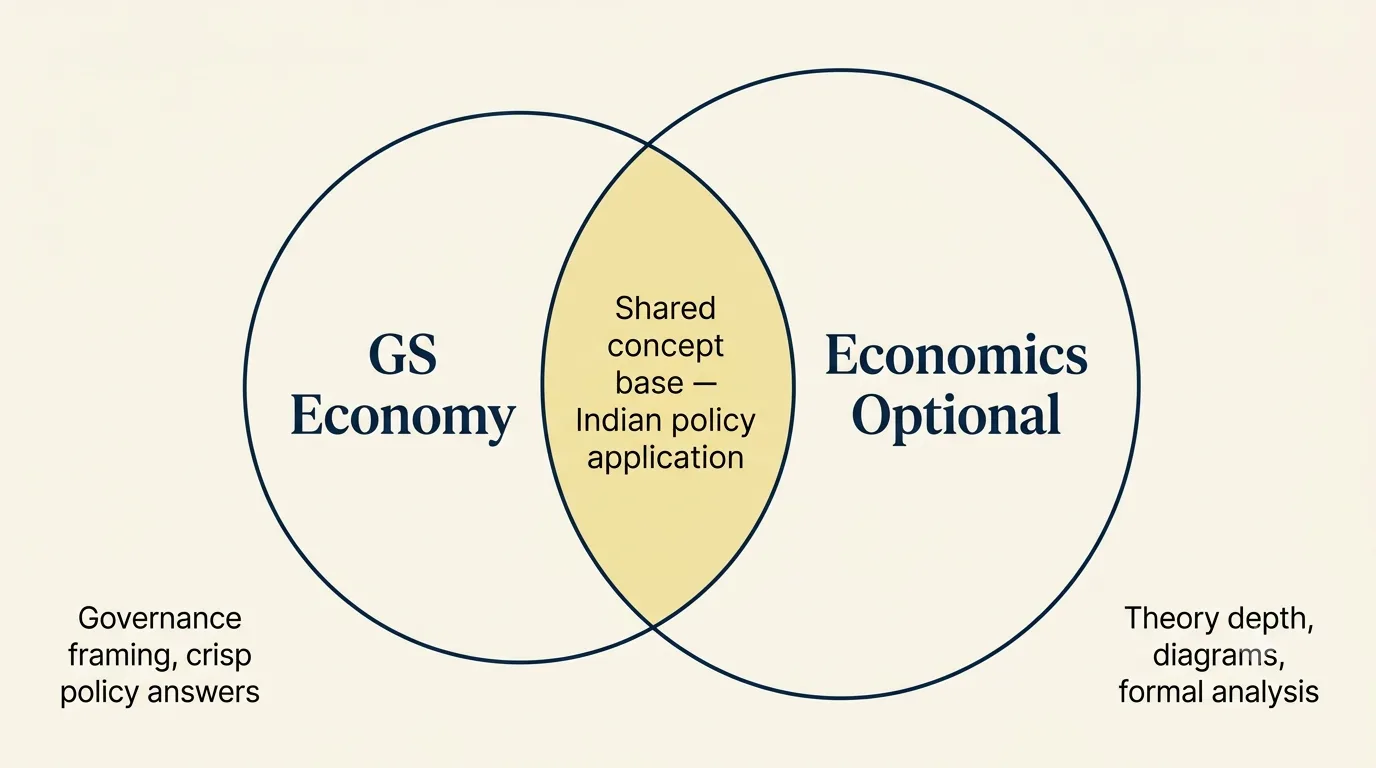
First — GS Economy and Economics Optional are not the same thing
A common confusion. Clearing it early makes the rest of this post make sense.
Swipe sideways to see all columns.
| GS Economy (part of GS Paper III) | Economics Optional (Papers VI + VII) | |
|---|---|---|
| What it asks | Can you understand economic issues at a governance level? | Can you think like an economist? |
| Answer style | Crisp, policy-oriented, current-affairs-linked | Structured analytical arguments with theory, diagrams and Indian application |
| Depth expected | Broad and current — Budget, Economic Survey, RBI announcements | Formal — micro, macro, public finance, international, growth, Indian economy |
| Marks | Part of GS Paper III (250 total) | 500 marks (Paper VI + Paper VII) |
If you take Economics optional, your Economics preparation naturally covers most of GS Economy. But GS answers still need to be short and policy-oriented; optional answers need depth and structure. Same concept base, different writing skill.
The case for Economics Optional
Four honest reasons.
1. GS Paper III overlap is unmatched
GS Paper III’s economy portion — Indian economy, growth, development, agriculture, infrastructure, budgeting, external sector, employment — is essentially “Economics lite”. If your Economics optional preparation is rigorous, the GS Economy syllabus is largely done as a by-product. You still need to convert that depth into crisp GS-style answers, but the underlying reading is not duplicated.
2. You have a head start
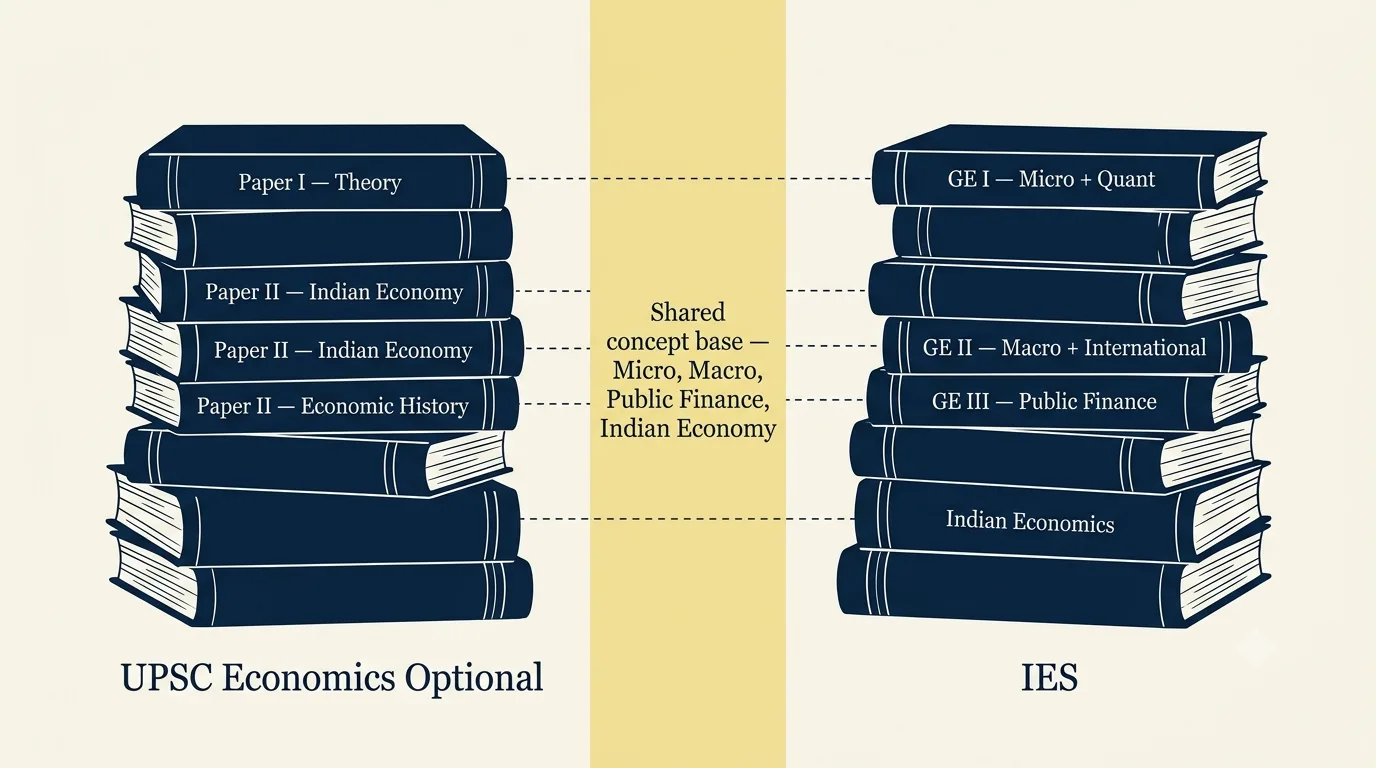
If you have done BA or MA Economics, the syllabus is not alien. You have seen the language. Micro, macro, public finance, growth, Indian economy — some of it is familiar territory. A non-Economics student is learning the language from scratch. That head start is a real, unshared advantage. It does not mean you are exam-ready; college Economics and UPSC Economics are different registers. But you are not starting from zero.
3. It builds a lens that improves the whole UPSC performance
Less obvious, but I have seen this repeatedly with our students.
Economics trains a specific way of thinking — trade-offs, incentives, constraints, unintended consequences, fiscal limits, policy design. That lens upgrades your GS II answers on governance and policy, sharpens your essays, and strengthens your interview, where economic-policy questions almost always come up.
Economics optional does not just prepare two papers. It builds an analytical lens that improves your entire UPSC performance.
4. The competition pool is smaller and more specialised
UPSC’s 2021 Annual Report reported the following approximate optional-wise candidate counts for CSE Mains (2021):
Swipe sideways to see all columns.
| Optional | Candidates who appeared (approx.) |
|---|---|
| Economics | ~190 |
| Public Administration | ~361 |
| Political Science & International Relations (PSIR) | ~1,571 |
Source: UPSC 2021 Annual Report. Verify current-cycle numbers against the latest annual report.
Economics is a smaller, more specialised pool. It has an entry barrier — you need real subject depth. If you already have an Economics background, that entry barrier becomes your moat.
The best optional is not the one that looks easiest on Day 1. It is the one where you can become better than the average candidate by exam day.
Does Economics optional produce top ranks?
Yes — this is one of the more persistent myths worth killing.
Recent UPSC CSE cycles have consistently produced top-100 (and top-10) ranks with Economics optional. Verify the current-cycle list against the UPSC CSE Final Result for the year you are appearing in.
Economics is not an “easy scoring” optional. It is a clear scoring optional. If your concepts are clear, your diagrams are correct, your arguments are structured, and your Indian examples are strong, the examiner will reward you. The candidates who struggle are almost always the ones who know the content but have not adapted their writing style. That is a fixable problem — not an inherent weakness of the optional.
Takeaway. If you have an Economics background, genuine interest and are willing to practise answer writing seriously, Economics optional has an unusually clean strategic case — GS III overlap, essay-and-interview benefit, a smaller specialised competition pool, and it produces top ranks year after year. Read the concerns next, then decide.
Sources and further reading
- Union Public Service Commission — upsc.gov.in: CSE Notification and Economics Optional syllabus.
- UPSC Annual Reports — upsc.gov.in/annual-report: candidate counts by optional subject, including the CSE 2021 data cited above.
- UPSC CSE Final Results (year-wise) — upsc.gov.in/examinations/active-examinations: the authoritative record of rank-holders and their optionals.
- Economic Survey — indiabudget.gov.in/economicsurvey: the primary reference for Paper II Indian Economy current affairs.
- Union Budget — indiabudget.gov.in: fiscal-side reference for Paper II.
- Reserve Bank of India — rbi.org.in: Monetary Policy Reports and Financial Stability Reports for money-and-banking and financial-sector portions.
On EcoNiti
- UPSC CSE Economics Optional at EcoNiti — full exam profile, syllabus map and our concept-first preparation approach for the two Optional papers.
- UPSC Economics Optional coaching with Dr. Komal — small online batches, Paper I and II teaching, evaluated answers and course fees.
- Free Economics Optional previous year papers — explore questions before deciding whether to enrol.