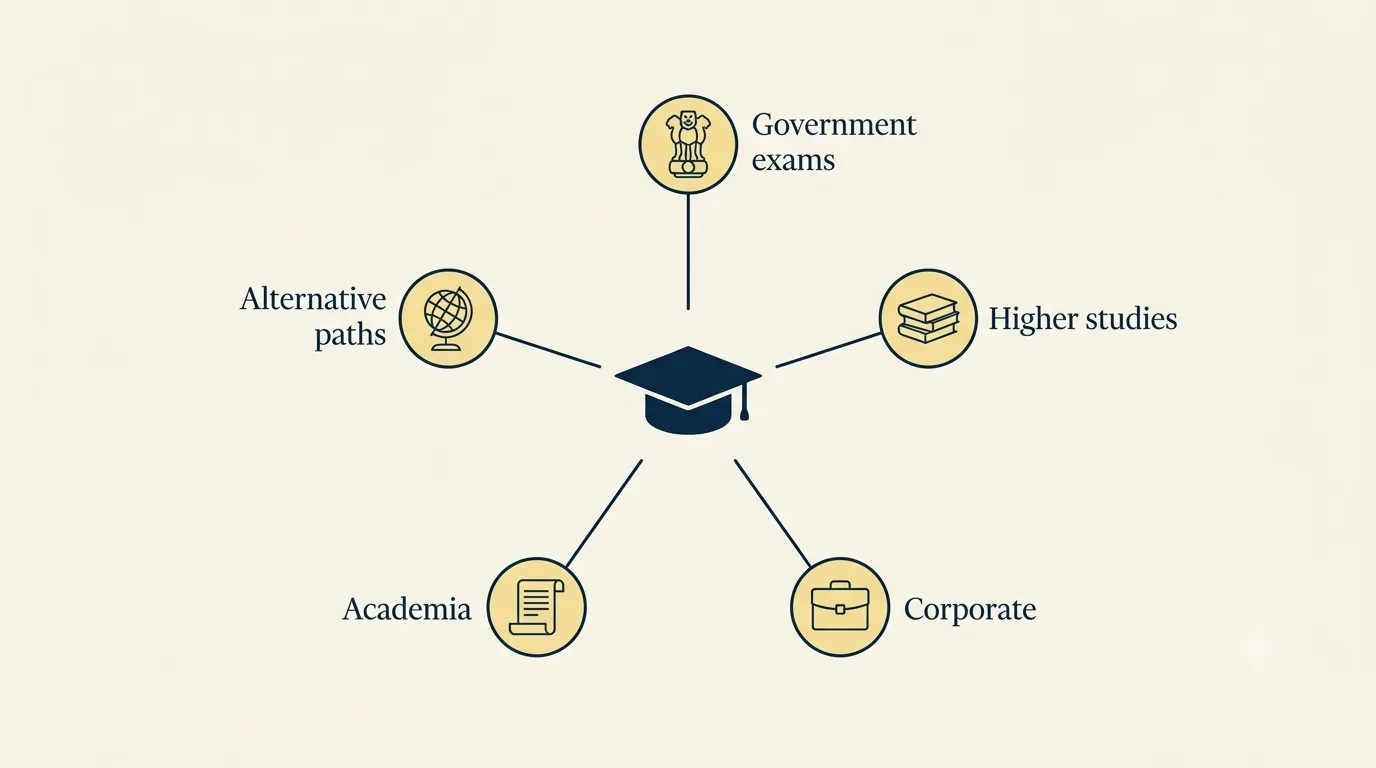
Every serious government-exam aspirant reaches the same fork within the first three months: what happens if the primary attempt does not clear? The instinct is correct — a backup is a real concern and deserves a real answer. What most students settle for is not one.
Preparing for UPSC, IES, RBI DEPR, State PCS, UGC NET and a few PSU exams “in parallel” is not a backup strategy. It is a schedule that guarantees mediocrity in every one of them. This post lays out the actual model — how to build a backup cluster around a primary — and clears out four common myths that push students into over-broad backups.
If you have not read Post 2, which compares UPSC CSE, IES and RBI Grade B DEPR on the dimensions that matter, read that first. This post assumes that comparison and builds on it.
Why “prepare for everything” fails
Three specific reasons.
1. The exams look similar; the preparation is not. UPSC CSE Prelims rewards breadth and MCQ pattern recognition. IES rewards structured Economics writing across six papers with no MCQ phase. RBI DEPR Phase II rewards depth in Micro, Macro, Quant Methods and Indian Economy. Preparing “for all three” usually collapses into preparing for none of them well.
2. Cycle lengths clash. UPSC CSE is a 12-month cycle. IES and RBI DEPR are 6–8-month cycles. Their peak preparation windows land at different times of the year, and answer-writing pressure ramps up in different weeks. Serious calendar planning around one primary is realistic; around three is a fantasy.
3. Answer-writing skill compounds by exam. UPSC writing style, IES writing style and DEPR writing style overlap but are not identical. You get much faster at all three by mastering one first; you get slower at all three by rotating between them from Day 1.
The cluster frame
Pick one primary exam. Build a small backup cluster around it — exams that share syllabus, skills and direction with the primary, so your primary preparation is largely their preparation too.
A good cluster satisfies three tests:
- Syllabus overlap. At least 60% shared reading with the primary.
- Skill overlap. Same answer-writing register (analytical + Indian applications), similar diagram or derivation load.
- Career direction fit. If the backup clears, is the job actually one you would take?
The last test matters. There is no point clearing an exam whose job you would decline. The backup exists to reduce anxiety, not to add prestige.
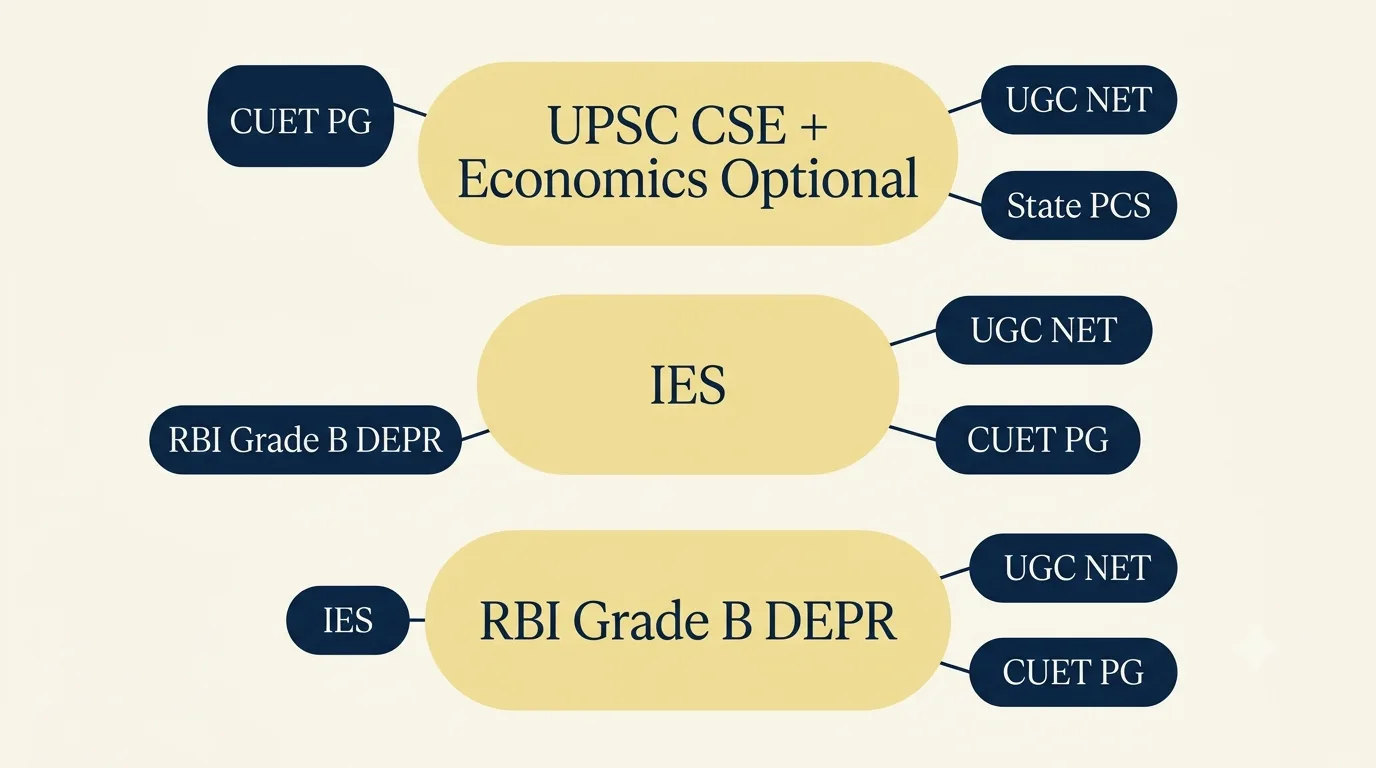
Three primary paths, three cluster shapes
Path A — UPSC CSE as primary
- Primary: UPSC CSE with Economics optional.
- Academic backup: UGC NET Economics — if teaching or academia is your fallback. Your Optional prep covers most of NET’s Paper II.
- Entrance backup: CUET PG Economics — only if a stronger MA programme is still relevant for your stage.
- Administrative backup: State PCS. The preparation pattern overlaps with UPSC far more than with IES or DEPR.
Path B — IES as primary
- Primary: Indian Economic Service.
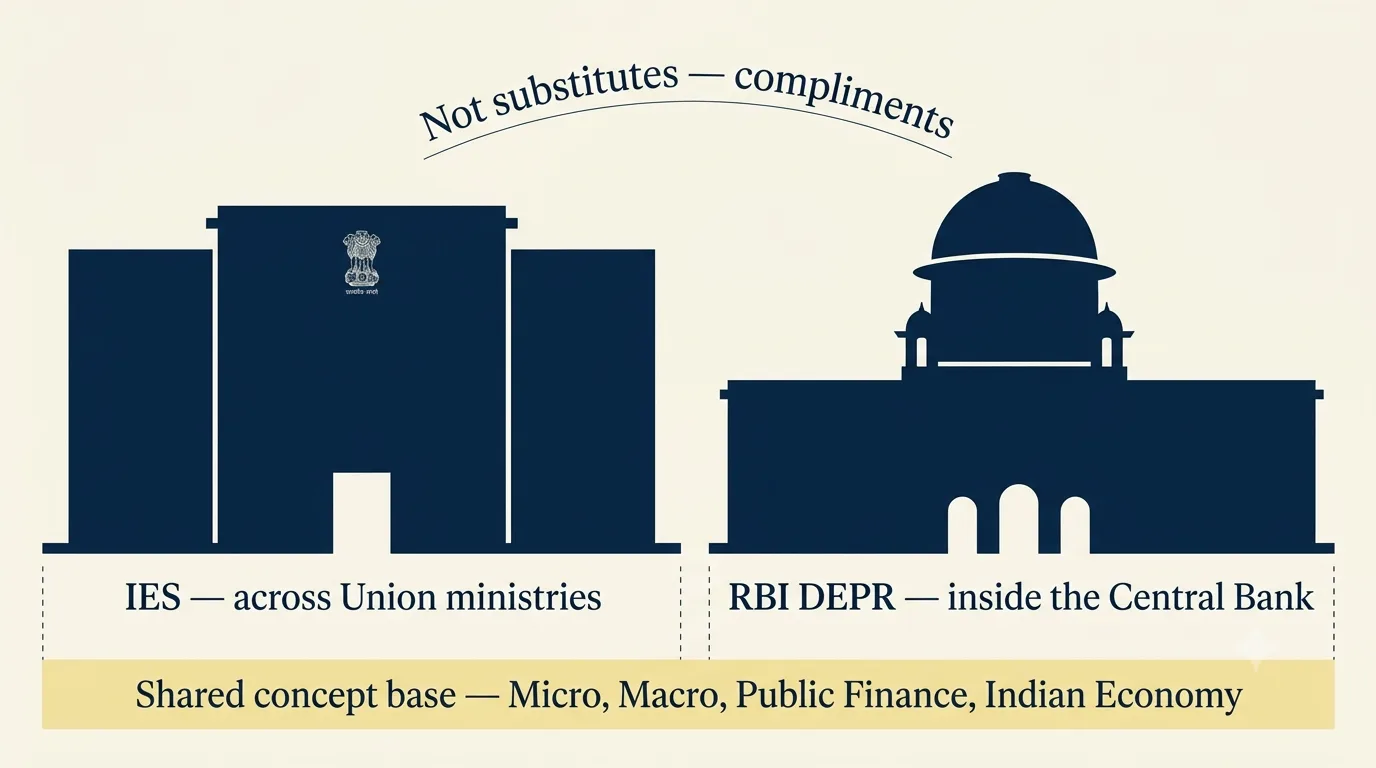
- Closest backup: RBI Grade B DEPR. Both are specialist Economics exams; the core concept base is shared, even where the flavour differs.
- Academic backup: UGC NET Economics.
- Skip: UPSC CSE full preparation. A separate 2–4-year commitment is not a “backup” — it is a second primary.
Path C — RBI Grade B DEPR as primary
- Primary: RBI Grade B DEPR.
- Closest backup: IES. Same reasoning as Path B in reverse. IES asks for broader coverage (public finance, statistics, descriptive writing) but the concept base is shared.
- Academic backup: UGC NET Economics.
- Skip: RBI Grade B General and DSIM as “insurance”. Different eligibility, different work — see Post 9 on the three RBI tracks.
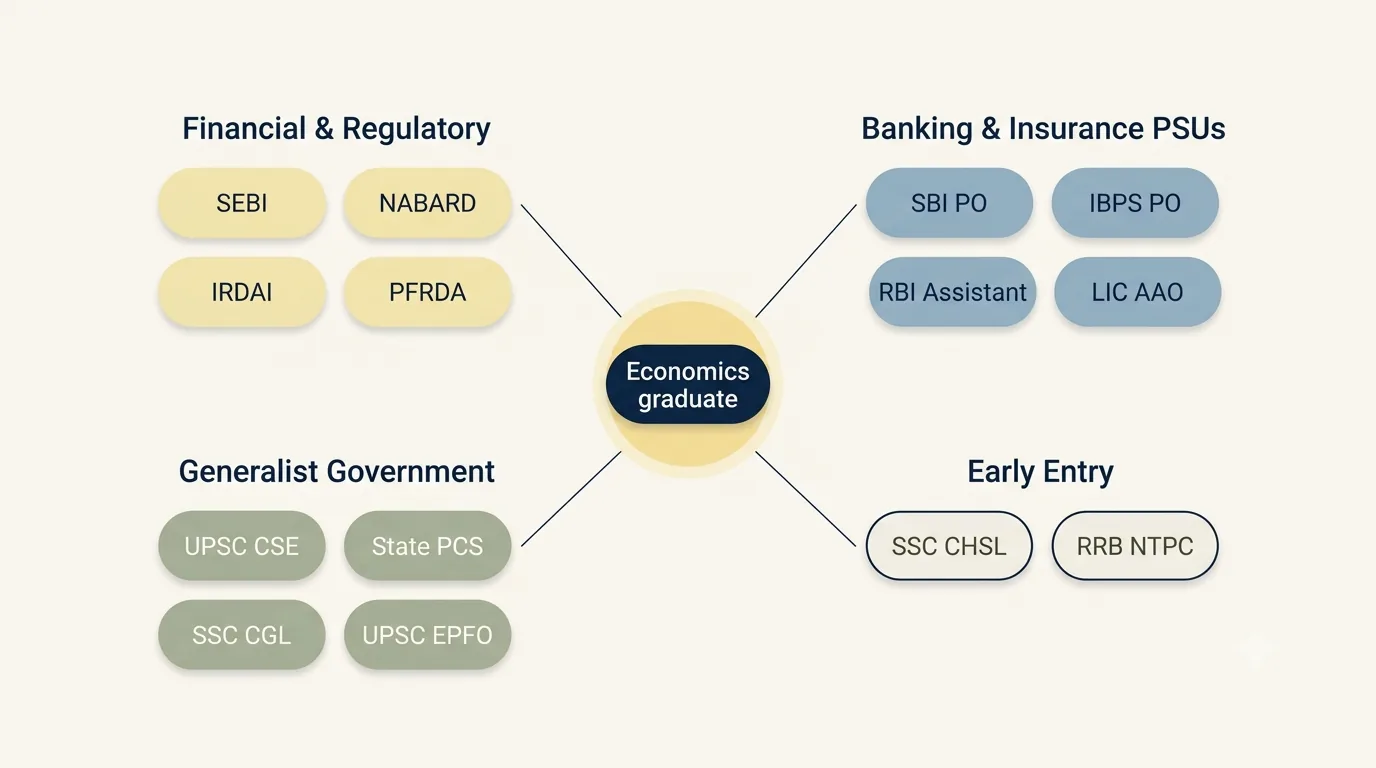
Notice what is missing from every cluster: five random exams stitched together. A serious cluster has three items, one of which is academic. Anything more is noise dressed up as strategy.
Four myths that produce fake backups
Myth 1 — “Attempt every exam whose eligibility I meet.” Eligibility is not selection. Every extra exam is time not spent on your primary. Attempt the ones whose preparation is 80% shared with your primary; skip the rest.
Myth 2 — “A tougher exam trains you for the easier ones.” True for the concept base — not for the writing style. UPSC CSE writing style will not directly train you for IES answer writing, and DEPR MCQ pace is a different skill from UPSC Prelims pace. Concept transfer is real; skill transfer is not automatic.
Myth 3 — “The more attempts, the higher my odds.” Odds compound only when preparation quality holds. Splitting a fixed number of hours across four exams usually pushes each below the quality threshold that produces results at all.
Myth 4 — “A backup means every option kept open.” A good backup reduces anxiety. If your backups increase confusion, they are not backups — they are noise.
One test before you finalise your cluster
Sit with a blank sheet and answer three questions.
- What is my primary? One exam. One line.
- Which two exams share at least 60% of their preparation with my primary? Those are your backup cluster.
- Would I take the job if any of the cluster exams cleared and my primary did not? If the answer is no for any of them, drop it.
If your list still has five items after this test, you have not finished the test.
Takeaway. A real backup cluster is small, syllabus-aligned and honest about the jobs on offer. Pick a primary. Cluster two or three exams around it that share the reading and the writing style. Skip the rest — including the ones your peers are attempting. Focus is what compounds.
Sources and further reading
- Union Public Service Commission — upsc.gov.in: CSE and IES / ISS notifications and syllabi.
- Reserve Bank of India, Opportunities — opportunities.rbi.org.in: Grade B (General, DEPR, DSIM) notifications.
- UGC NET — ugcnet.nta.ac.in: the academic-backup route through NET Economics.
- Economic Survey and Union Budget — indiabudget.gov.in: the Indian Economy references shared across UPSC, IES and RBI DEPR.
On EcoNiti
- UPSC CSE Economics Optional, IES and RBI Grade B DEPR — the three primary exams around which serious Economics-graduate clusters are built.
- UGC NET Economics — the academic backup that fits every cluster.