For a serious Economics postgraduate, three exams sit on the table together: UPSC Civil Services, the Indian Economic Service (IES), and RBI Grade B DEPR. Students often lump them into “government exams” and imagine they can prepare for all three in parallel as insurance for each other. They cannot. These are three different jobs, three different exams, and three different daily lives.
This post separates them cleanly on the dimensions that actually matter and walks through the four decision questions from Post 1. The follow-up on how to build a real backup — one primary plus a small syllabus-aligned cluster — is in Post 3.
Quick orientation
In one line each:
Swipe sideways to see all columns.
| Exam | Trains you to be |
|---|---|
| UPSC Civil Services (CSE) | A generalist administrator or diplomat — IAS, IPS, IFS, IRS and other central services. |
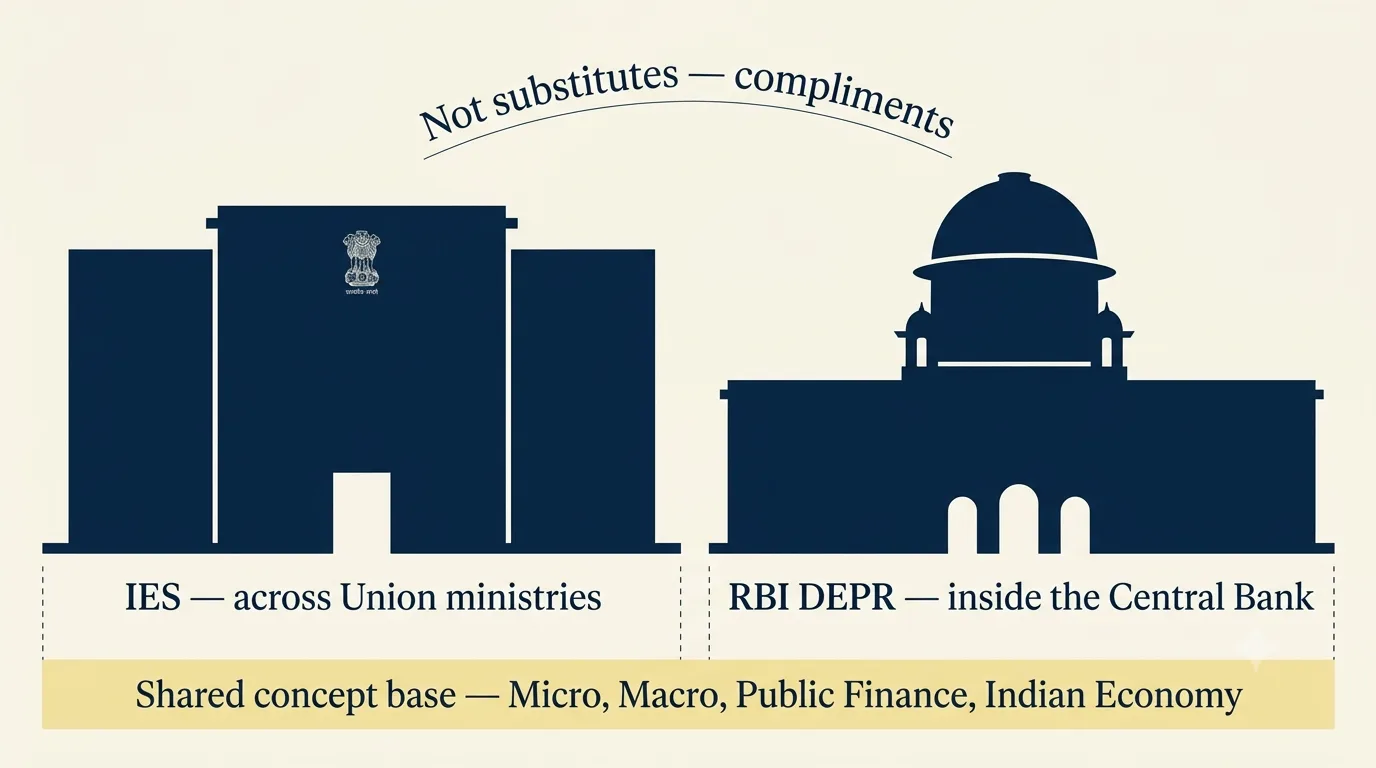
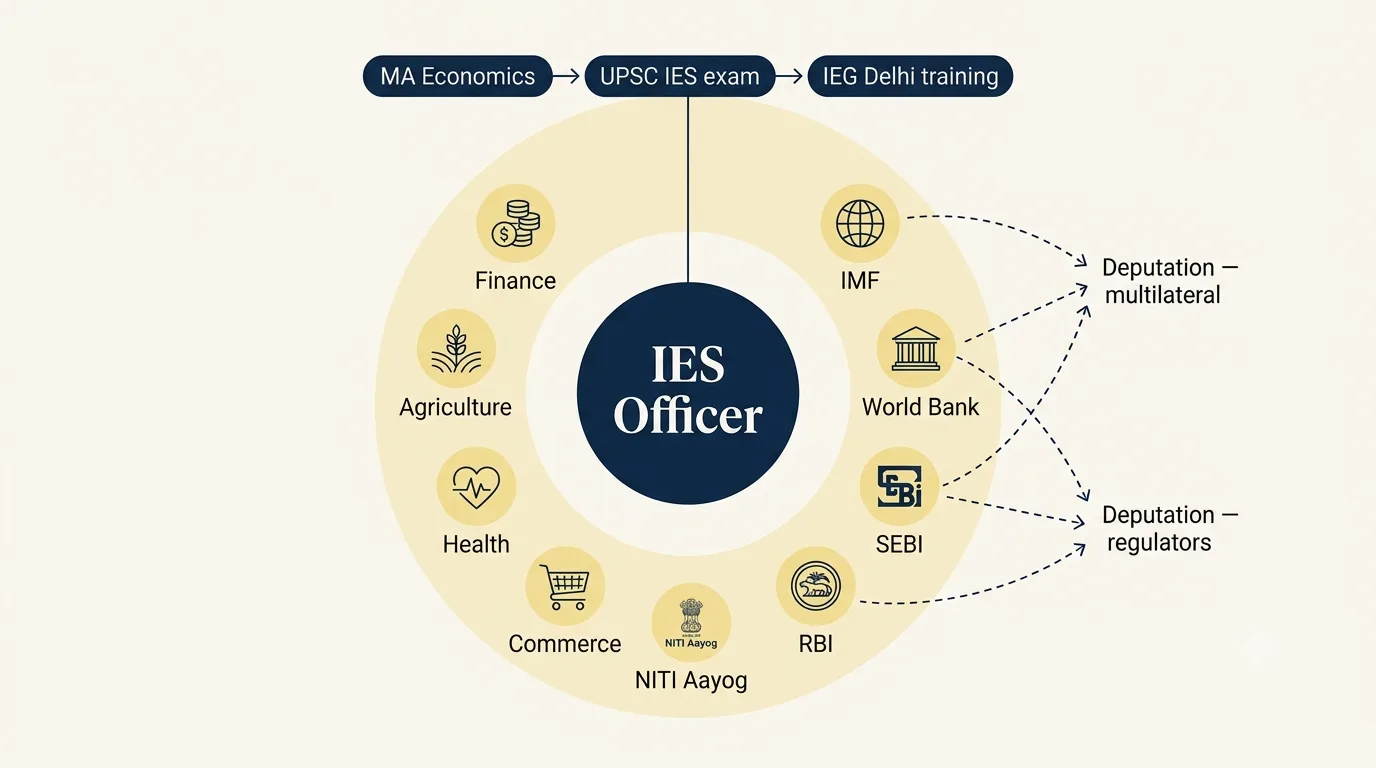
| Indian Economic Service (IES) | A specialist government economist inside the Union ministries (Finance, Agriculture, Health and ~52 others). |
| RBI Grade B DEPR | A specialist central-bank economist inside the Reserve Bank of India’s Department of Economic and Policy Research. |
- UPSC uses Economics as one lens on a much wider governance job.
- IES and RBI DEPR make Economics the job itself.
You are effectively choosing between “administrator who thinks like an economist” and “economist who works inside government or the central bank”.
The comparison, on the dimensions that matter
Swipe sideways to see all columns.
| Dimension | UPSC CSE | Indian Economic Service | RBI Grade B DEPR |
|---|---|---|---|
| Minimum degree | Graduation in any subject | Postgraduate degree in Economics / Applied Economics / Business Economics / Econometrics | Postgraduate degree in Economics (or a closely related quantitative field, per the annual notification) |
| Typical age (unreserved) | 21–32 | 21–30 | 21–30 (with age relaxation for M.Phil / PhD holders) |
| Selection rate | Well under 1% across all attempts | Small pool, small seats — but a specialist competition | Small pool, small seats — but a specialist competition |
| Cycle length | ~12 months (Prelims → Mains → Interview) | 6–8 months (Written → Interview) | 6–8 months (Phase I → Phase II → Interview) |
| Serious prep window | 2–4 years | 6–12 months | 8–15 months |
| Breadth vs depth | Extreme breadth — polity, history, geography, ethics, environment, economy, current affairs | Deep Economics across micro, macro, public finance, growth, international, statistics and Indian economy | Deep Economics with heavy weight on macro, monetary, banking, financial markets and Indian economy |
| Day-to-day work | Administration, districts, schemes, ministries, law and order — high public exposure | Policy notes, sectoral analysis, budgets, scheme evaluation, ministry-level economic advice | Macro & monetary analysis, forecasting, financial-stability research, input into MPC and RBI publications |
| Salary and lifestyle | Modest gross pay, but influence, official accommodation and public authority in cadre postings | Central-government pay scale + benefits; substantive policy work; less public-facing | Among the strongest government-sector packages; Mumbai posting for most; good work-life balance |
A few things worth pulling out of the table.
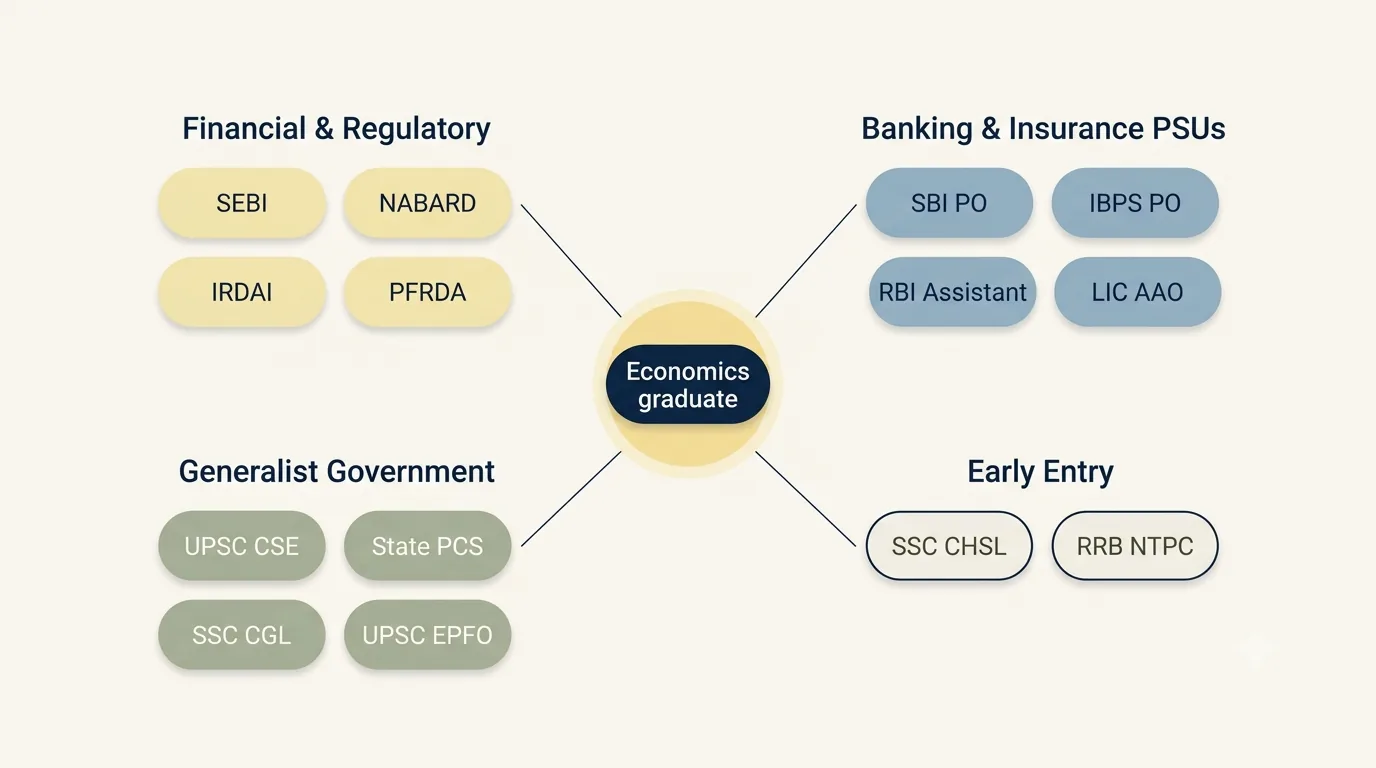
On eligibility. UPSC CSE is genuinely open to any graduate. IES and RBI DEPR are not — a postgraduate Economics degree (or a closely related quantitative discipline for RBI, per notification) is a hard requirement. If you have only a BA, only UPSC CSE, State PCS and CUET PG (as a route to MA) are immediately in play.
On difficulty. All three are hard. But they are hard in different ways. UPSC rewards breadth, stamina and answer-writing under pressure across a huge syllabus. IES and RBI DEPR reward Economics depth and the ability to write structured analytical answers within Economics. If Economics is your strength, IES and DEPR give your training much more leverage.
On seats. IES and RBI DEPR have small notified vacancies each year — typically single-digit to low-double-digit. The counter-intuitive point is that small seats plus a small, well-prepared, defined pool can still mean a better hit rate than a very large but generalist pool like UPSC CSE. Verify the exact numbers in the current-cycle notification (see Sources below).
The four decision questions, applied
1. Time horizon
- 21, just finished BA, three years free. UPSC CSE as primary makes sense. Start an MA in parallel so IES and RBI DEPR open up as backups from year 2 or 3.
- 24–25, finishing MA, want a job within 18 months. IES and RBI DEPR are far more rational than UPSC CSE.
2. Risk tolerance
- High tolerance, no urgent income pressure. UPSC CSE stays on the table.
- Lower tolerance, financial pressure or family responsibilities. IES and RBI DEPR are more predictable investments of your preparation time.
3. Genuine interest
- Field administration, districts, law and order, public negotiation → UPSC (specifically IAS / IPS tracks).
- Public finance, development, scheme design, ministry work → IES.
- Monetary policy, inflation, banking, macro data → RBI DEPR.
If your honest answer to Question 3 is monetary policy or public finance, and your answer to Question 4 is analytical rather than public-facing, choosing UPSC CSE just because it is the most famous option is not strategy — it is defaulting.
4. Job suitability
- Public-facing, high-energy, uncertainty-tolerant → UPSC (IAS-heavy).
- Analytical, reading- and writing-heavy, quiet institutional environment → IES or RBI DEPR.
What about backup exams?
If you have picked a primary, the next question is how to build a real backup — not five parallel preparations. The full model (one primary, a small syllabus-aligned cluster, three exams that share ≥60% preparation with your primary, four myths that push students into fake backups) is in Post 3 — the backup cluster strategy.
The one warning worth repeating here: the strategy that reliably fails is “I will prepare for UPSC, IES and RBI DEPR equally, in parallel, from day one.” Choose a primary. Build a cluster around it. Execute with focus.
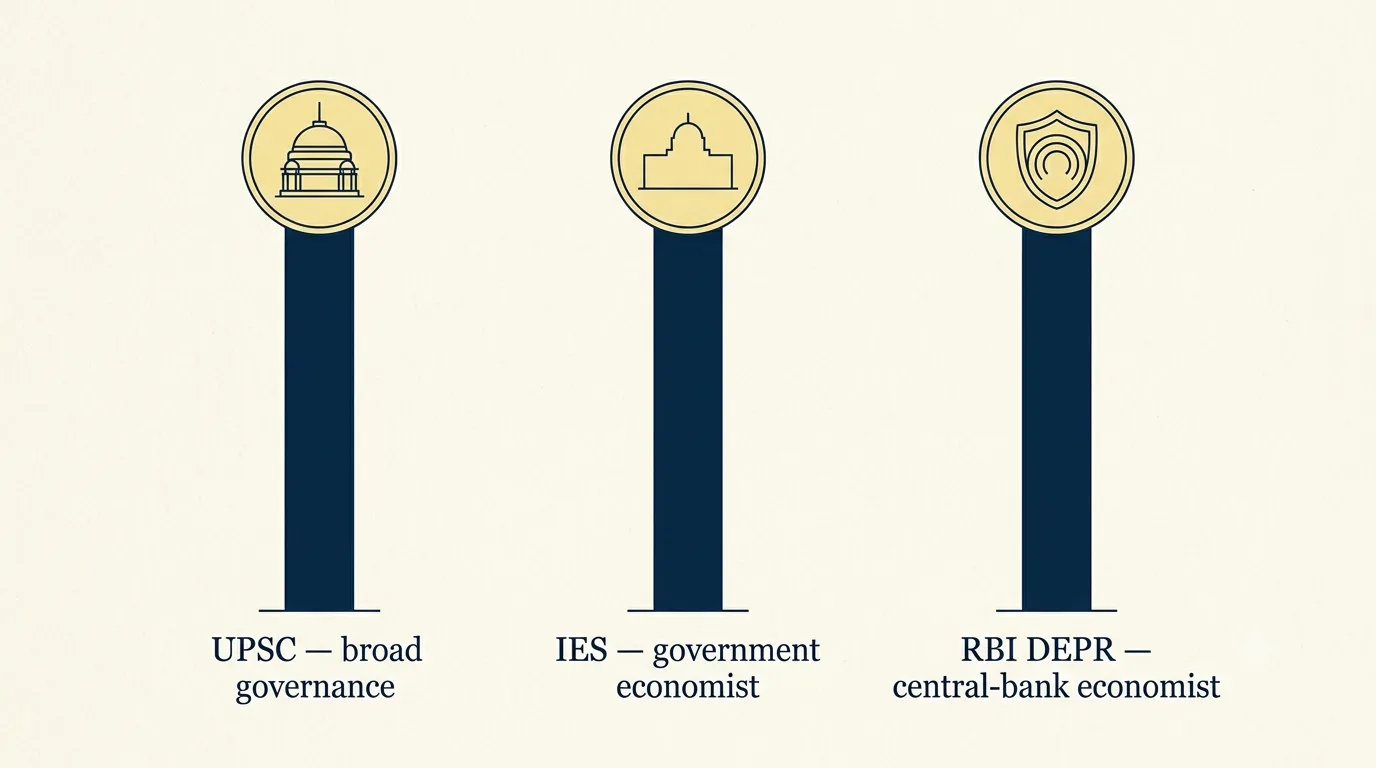
Takeaway. UPSC is broad governance. IES is government economist. RBI DEPR is central-bank economist. All three are excellent options for different kinds of people. Don’t choose on prestige; choose on fit — and build one honest backup cluster around the choice.
Sources and further reading
- Union Public Service Commission — upsc.gov.in: Civil Services Examination Notification and Indian Economic Service / Indian Statistical Service Notification (annual). Vacancies, age limits and exam dates for the current cycle are here.
- Reserve Bank of India, Opportunities — opportunities.rbi.org.in: Grade B (General, DEPR, DSIM) recruitment notifications, including current-cycle vacancies and exam dates.
- Ministry of Finance, Department of Economic Affairs — dea.gov.in: the ministry that manages the IES cadre.
- Institute of Economic Growth, Delhi — iegindia.org: the training academy for IES officers.
- Economic Survey and Union Budget — indiabudget.gov.in: primary references for the Indian Economy portions of all three exams.
On EcoNiti
- UPSC CSE Economics Optional — exam profile and our preparation track.
- Indian Economic Service (IES) — exam profile and our preparation track.
- RBI Grade B DEPR — exam profile and our preparation track.