If you have just finished (or are finishing) an Economics degree, you have almost certainly received five contradictory pieces of advice from five different people. UPSC. MA. Corporate. PhD. RBI, IES, NET, think tanks, World Bank, consulting — everyone is right, and no one is helpful.
The problem is not that Economics has too few options. The problem is that no one has drawn the map.
This series is that map. In this first post I will not tell you which path to walk. I will lay out the five paths that actually exist, and give you the four questions you should be asking before you commit to any of them.
The five paths, laid out
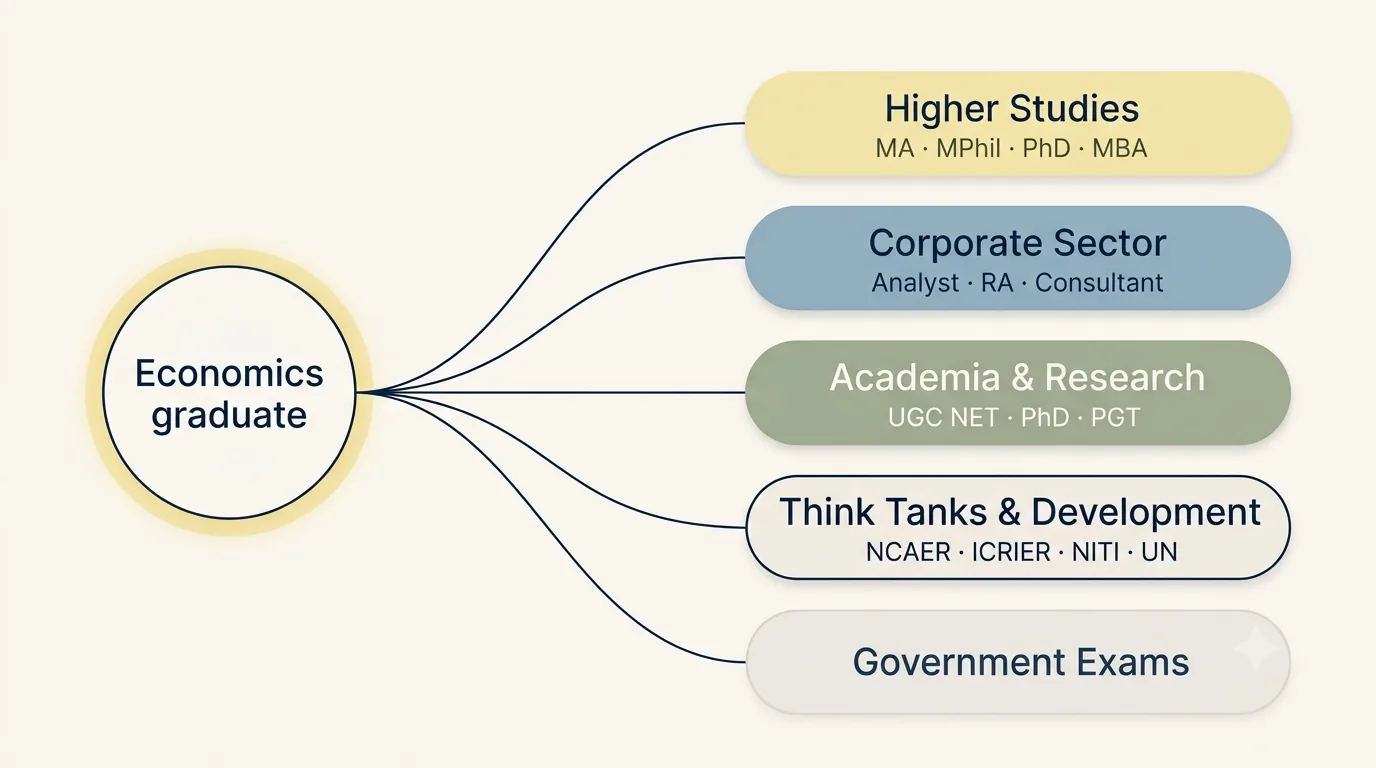
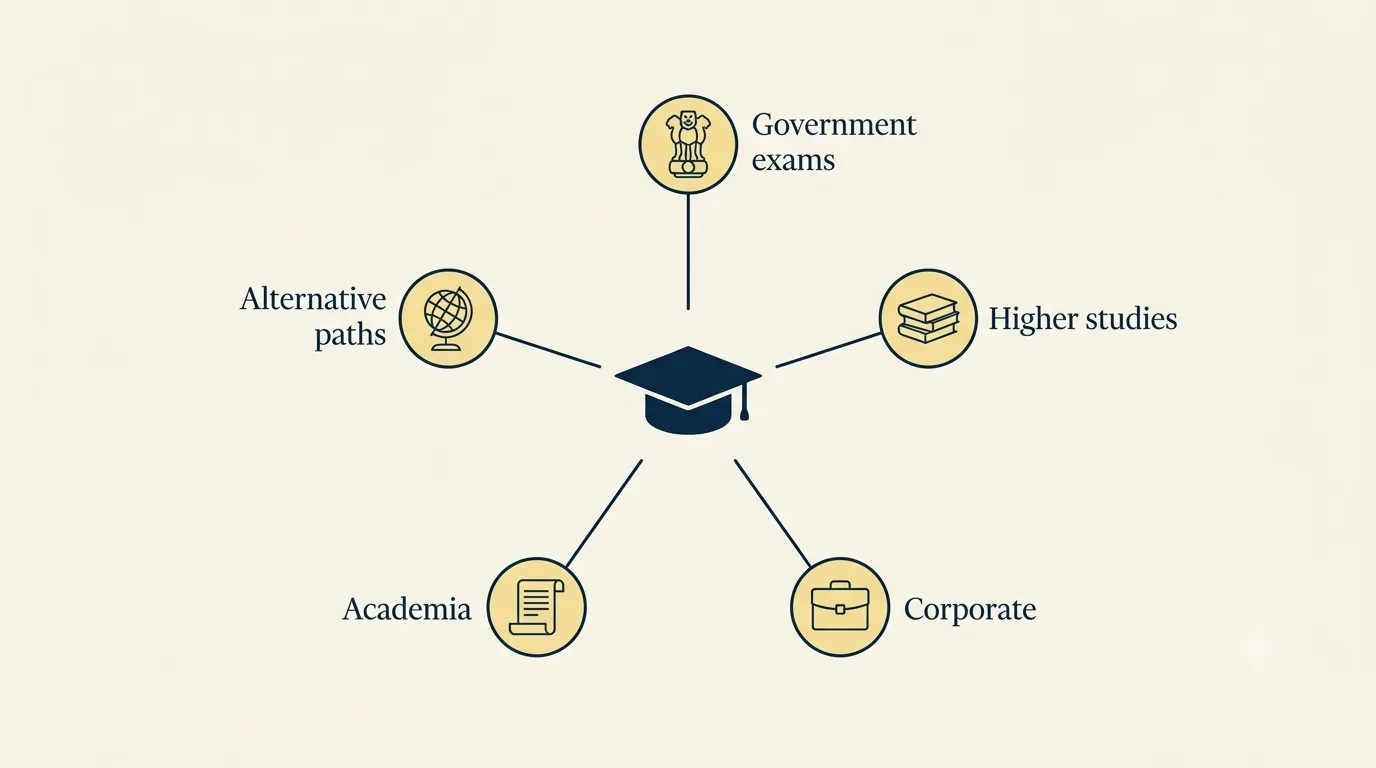
After Economics, every option worth taking falls into one of five families.
Swipe sideways to see all columns.
| Path | Typical entry | Minimum degree | Cycle length | Marquee exams / qualifications |
|---|---|---|---|---|
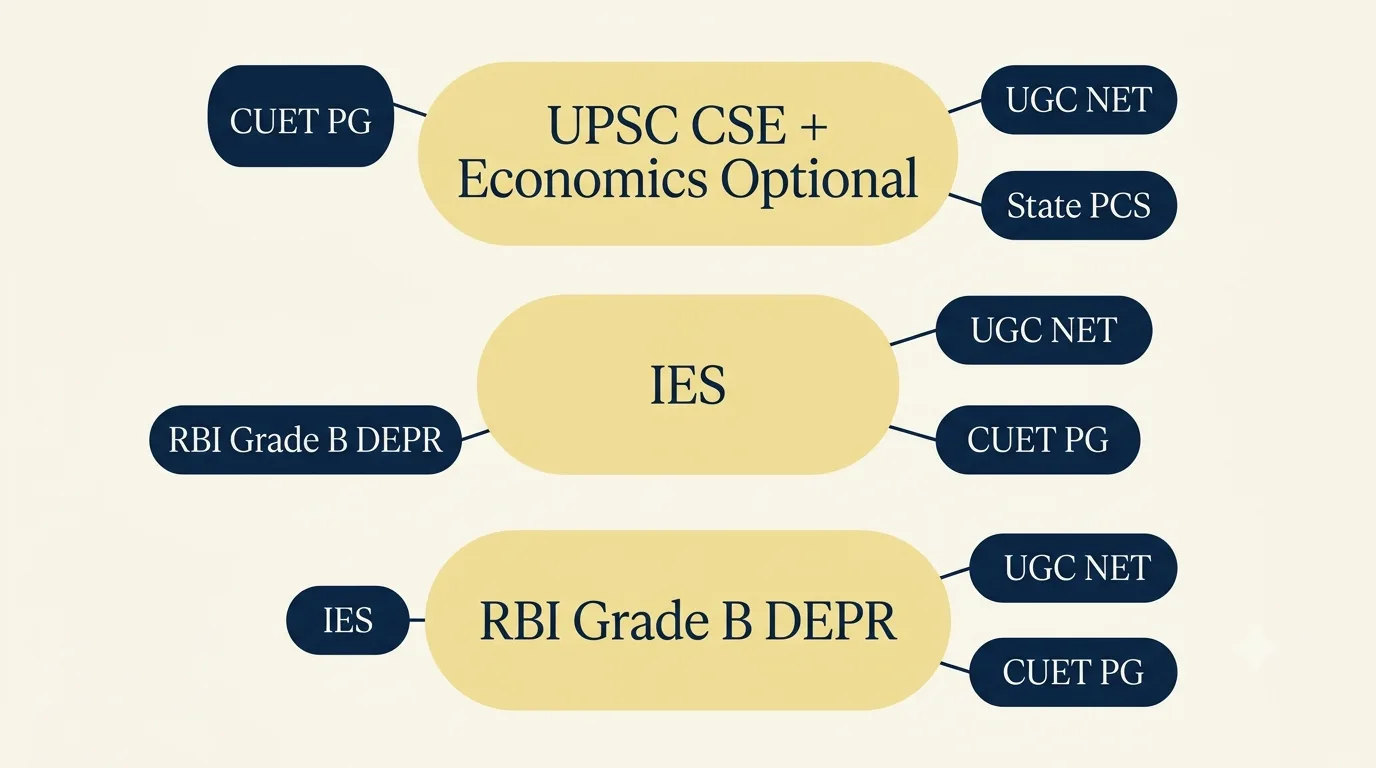
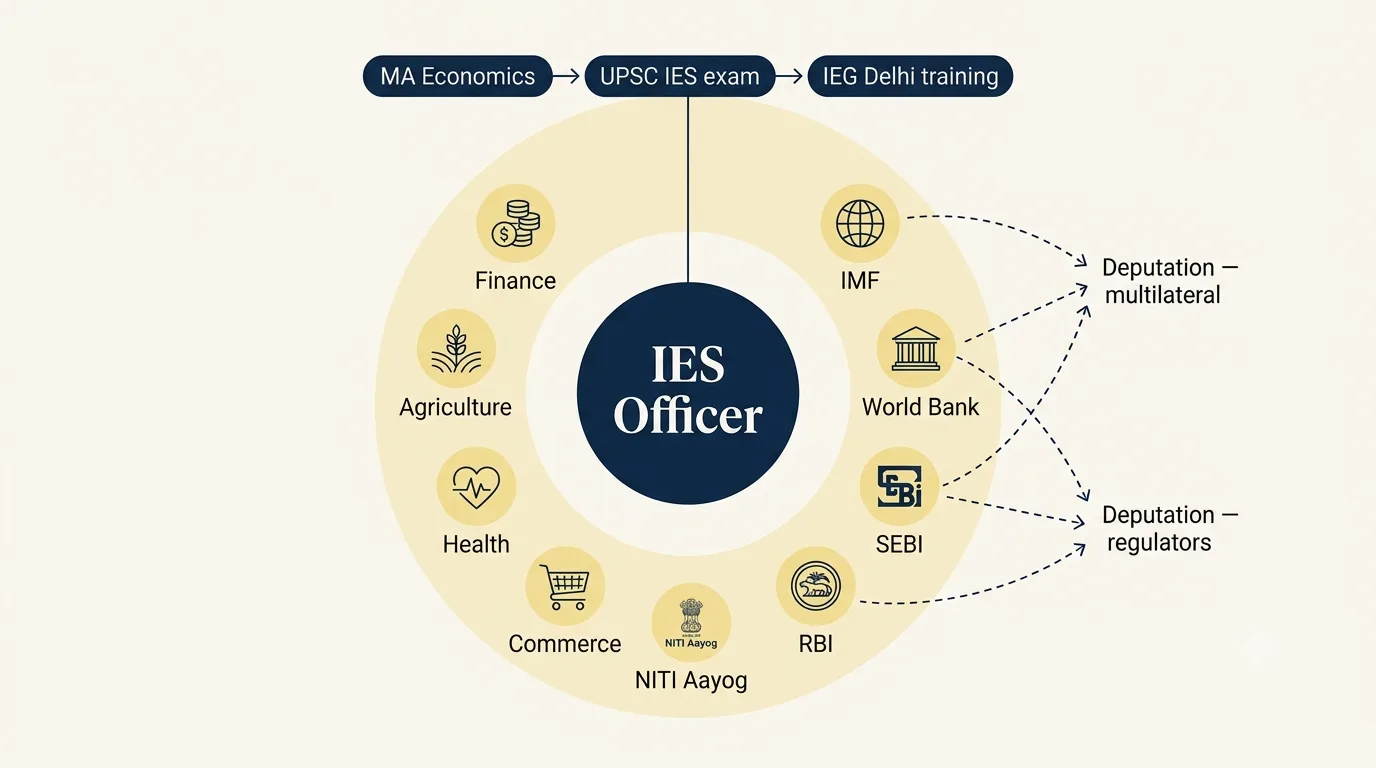
| 1. Government / policy exams | Competitive exam | BA (some), MA (others) | 6–36 months per exam | UPSC CSE, State PCS, SSC, Indian Economic Service, RBI Grade B DEPR |
| 2. Higher studies | Entrance + interview | BA / MA / MPhil | 2–6 years | CUET PG, DSE / JNU / IGIDR / ISI entrances, GRE (abroad), MBA (CAT / GMAT) |
| 3. Private sector / corporate | Placement or lateral | MA Economics preferred | Ongoing | Analyst, consultant, economist roles at banks, consultancies, corporates |
| 4. Academia and research | UGC NET → PhD → Assistant Professor | MA Economics | 6–8 years to a permanent post | UGC NET / JRF, PhD entrances, ISI / IIM research fellowships |
| 5. Alternative / emerging | Fellowships, projects, RA-ships | BA / MA depending on role | Variable | Think tanks (NCAER, NIPFP, ICRIER), NITI Aayog fellowships, multilateral (World Bank, IMF, ADB, UN) roles |
A few practical notes on this table.
- BA vs MA is a real fork. With a BA you already have UPSC CSE (all optionals), State PCS, SSC, CUET PG and later NET-eligibility through MA in play. An MA opens IES, RBI Grade B DEPR, corporate economist roles and PhD admissions.
- These families are not mutually exclusive. Many careers combine two — a PhD (Path 4) that leads to a policy role at NIPFP (Path 5), or an MA (Path 2) that leads to IES (Path 1).
- What is not on this list matters too. Data science, quant trading, actuarial science and product management are reasonable Economics-adjacent pivots. This series is written for students whose primary training and interest is Economics itself.
The four questions that decide it
Sit with these before you decide anything. There is no correct answer to any of them; there is only your answer.
1. What is your time horizon?
Are you a 21-year-old BA graduate with three untouched years ahead, or a 25-year-old finishing MA who needs a stable income within 18 months? Time is the single strongest constraint on which path is realistic.
- Long horizon (3+ years): UPSC CSE, PhD, MBA abroad are all in play.
- Short horizon (0–2 years): IES and RBI Grade B DEPR are far more rational than UPSC CSE. Corporate placements are also on the table if you are in a good MA programme.
2. What is your risk tolerance?
Government exams in India are almost by definition high-variance bets. UPSC CSE is the extreme case — selection rate is well under 1% across all attempts. IES and RBI Grade B DEPR are also small-seat, high-competition exams, but the pool is defined (Economics postgraduates only) and the syllabus is focused, which meaningfully improves the hit rate for a well-prepared candidate.
- Higher tolerance, no urgent financial pressure: UPSC CSE, PhD.
- Lower tolerance, family responsibilities, financial urgency: IES, RBI DEPR, or a corporate role first.
3. What is your genuine interest?
Not what sounds prestigious. Not what your relatives recognise. What you would still enjoy reading about on a Sunday.
- Governance, administration, field decisions → UPSC CSE.
- Public finance, development, scheme design → IES.
- Monetary policy, inflation, banking, macro data → RBI DEPR.
- Building original knowledge → academic PhD.
- Applied Economics inside firms → corporate roles.
If you do not know yet, that is fine. Interest often becomes visible only after you touch the work. Question 3 is the one that grows into itself.
4. What is your job suitability?
The exam is a gateway. What matters is the job on the other side of it. Before you commit to a two-year preparation, talk to at least one person who is actually doing the job you are preparing for. What does a Grade B DEPR officer’s Tuesday look like inside RBI Central Office? What does an IES officer’s day look like at the Department of Economic Affairs? What does a District Collector’s Tuesday morning feel like?
Some roles reward analytical, quiet, writing-heavy temperaments. Others reward high-energy, public-facing, decision-under-pressure ones. Both are valuable. Neither is universally better.
Bottom line. A degree in Economics is one of the most flexible degrees that exists. If you have imbibed Economics in the true sense, it is not a subject — it is a way of thinking. That thinking transfers to almost every one of the five paths above. What you have to decide is which one.
Sources and further reading
- Union Public Service Commission — upsc.gov.in — Civil Services, Indian Economic Service and Indian Statistical Service notifications and syllabi.
- Reserve Bank of India, Opportunities — opportunities.rbi.org.in — Grade B (General, DEPR, DSIM) recruitment notifications.
- Ministry of Finance, Department of Economic Affairs — dea.gov.in — the ministry that manages the Indian Economic Service cadre.
- UGC NET — ugcnet.nta.ac.in — the entry point for JRF, Assistant Professor eligibility and (for many students) academic careers in Economics.
- Economic Survey and Union Budget — indiabudget.gov.in — annual government-of-India documents that anchor all Indian Economy preparation.
On EcoNiti
- UPSC CSE Economics Optional — the case for the optional, the syllabus, and our concept-first preparation.
- Indian Economic Service (IES) — cadre profile, exam pattern and our IES preparation track.
- RBI Grade B DEPR — the three RBI tracks and our DEPR preparation approach.
- UGC NET Economics — for academic and Assistant Professor pathways.
- CUET PG Economics — the entrance route to a stronger MA programme.
Questions students ask
How do I choose between UPSC, IES, RBI Grade B DEPR and higher studies after an Economics degree?
Answer four questions honestly — What is your time horizon (short means IES / DEPR, long means UPSC or PhD)? What is your risk tolerance? What is your genuine interest (governance vs public finance vs monetary policy vs research)? And what is your job suitability (public-facing vs analytical)? The answers decide the path.
Which exam has the shortest cycle after MA Economics?
IES and RBI Grade B DEPR both have 6–8 month cycles. UPSC CSE is 12 months. For an MA Economics student who wants a job within 18 months, IES or DEPR are more rational than UPSC CSE.
Can I prepare for UPSC, IES and RBI DEPR at the same time?
No. UPSC rewards breadth. IES and DEPR reward Economics depth. Preparing for all three in parallel from Day 1 usually results in clearing none. Pick one primary and build a syllabus-aligned backup cluster of two or three exams around it.