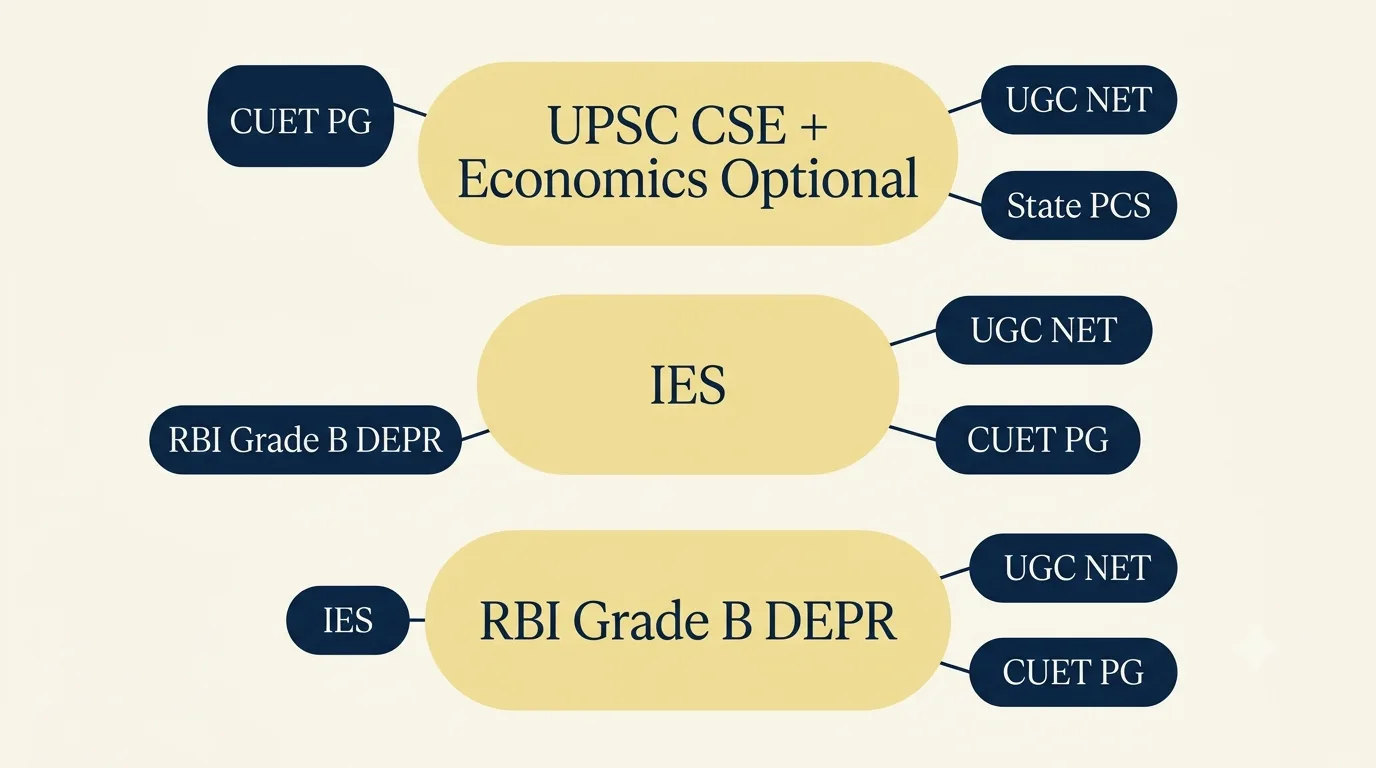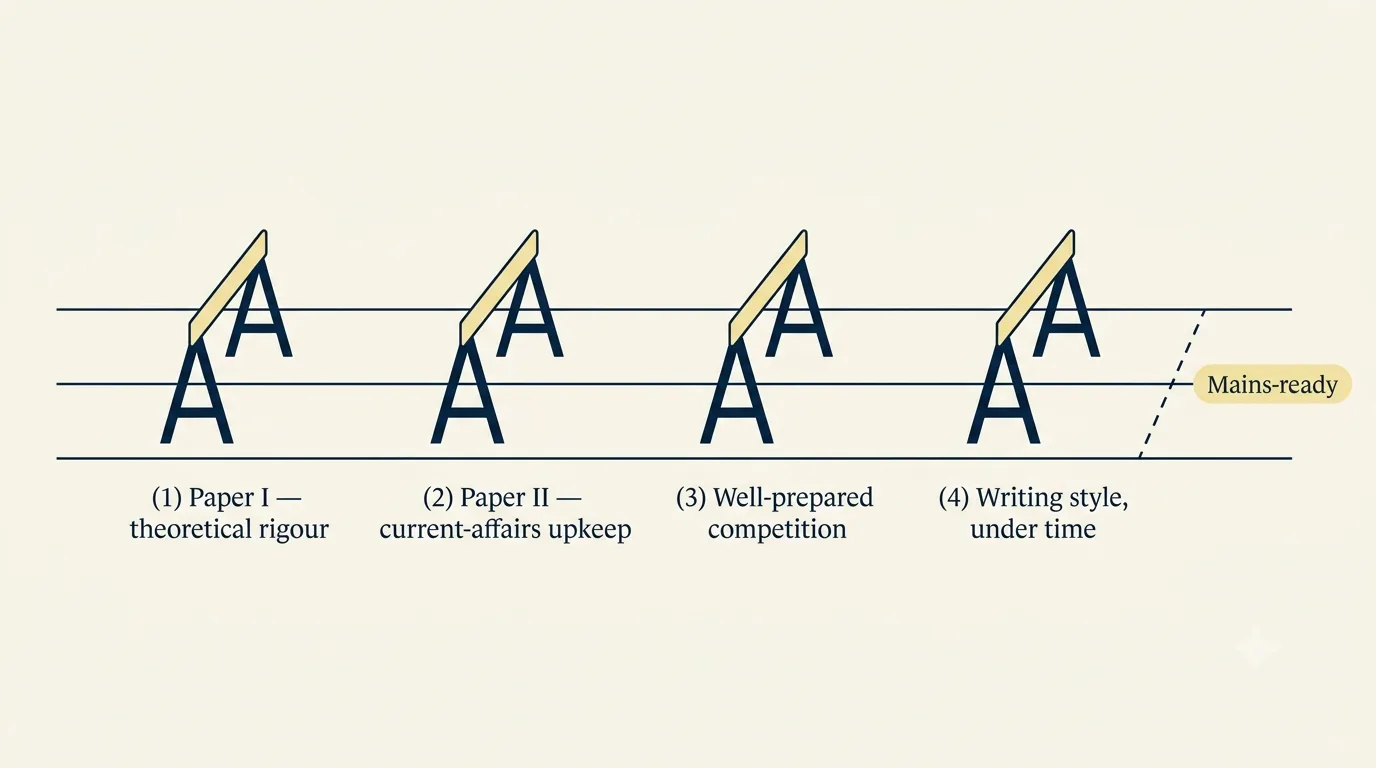
Over twelve posts and a full video series, we have walked through the government path in unusual depth — the framework, the three specialist peaks, the backup cluster strategy, and now the wider government-exam map.
There is a specific kind of student this final post is written for. You have watched or read all of the above, honestly. And you still feel — quietly, without drama — that this is not your path. That is not doubt, and it is not lack of ambition. It is data. UPSC, IES and RBI DEPR are all high-commitment, high-delayed-gratification bets, and not every Economics student is built for that particular bet. Interest, risk tolerance and time horizon vary honestly across people.
So today, no specialist exam. This post maps the four paths that open up outside the government route — higher studies, the corporate sector, academia and research, and alternatives — and closes the series with the four questions that decide which one is yours.
First — the same map, wider
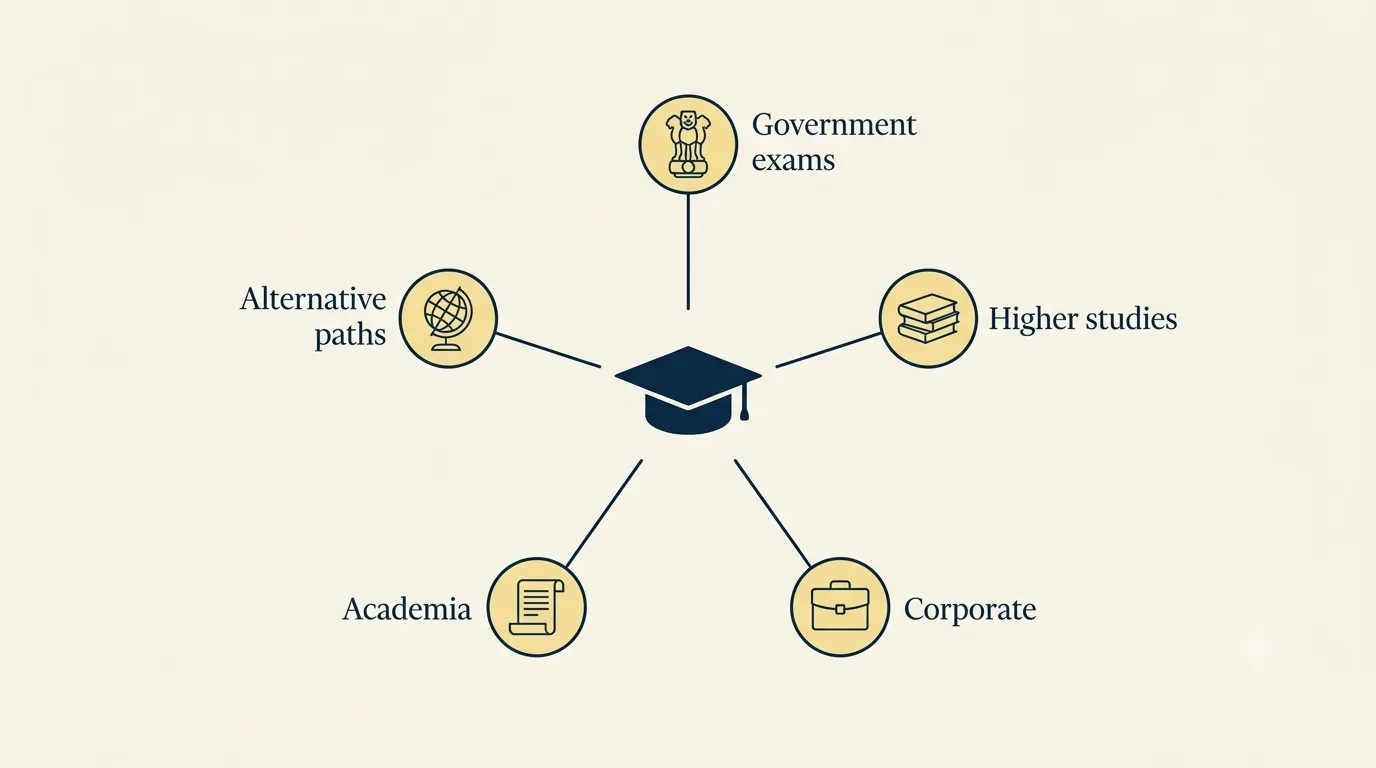
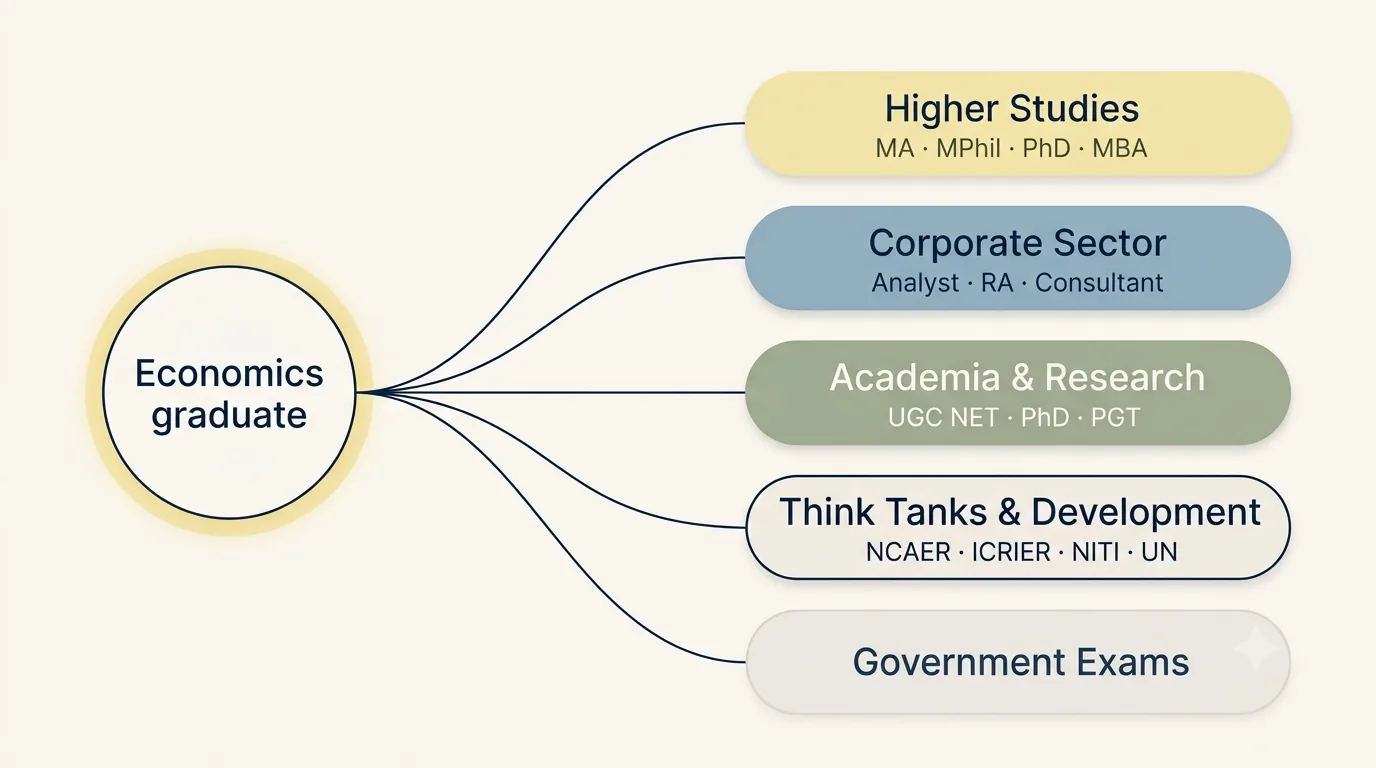
Return to the five broad paths from the first post. Paths 1 through 5 were: government and policy exams, higher studies, the corporate sector, academia and research, and alternatives. Twelve posts covered the government path — the peaks and the wider map. This post covers paths 2, 3, 4 and 5, in that order.
Swipe sideways to see all columns.
| Path | Typical entry | Best if you want | Realistic gestation |
|---|---|---|---|
| Higher studies | Entrance + interview | Depth in Economics, or a research or MBA pivot | 2–6 years |
| Corporate | Campus placement or lateral | Applied Economics inside firms, faster income growth | Ongoing |
| Academia and research | UGC NET / JRF → PhD → Assistant Professor | Teaching and research as a career | 5–8 years to a permanent post |
| Alternatives | Fellowships, internships, projects | Policy and social-impact work without an exam route | Variable, less structured |
The paths overlap at the edges — a PhD (academia) can lead into a think tank (alternative); an MA (higher studies) can lead into corporate placements. Take them as families, not silos.
1. Higher studies, taken seriously
If you have a bachelor’s, a master’s is a natural next step, in India or abroad. If you already have a master’s, an MPhil or a PhD opens up.
This path is for students who want to study Economics deeply, without the pressure of an exam calendar driving every semester. The goal is not a rank; the goal is understanding. In India, the strongest research cultures sit at the Delhi School of Economics, the Indian Statistical Institute (ISI), Jawaharlal Nehru University (JNU), and the Indira Gandhi Institute of Development Research (IGIDR). If you want to go abroad, the standard requirements are the Graduate Record Examination (GRE), a well-argued Statement of Purpose, and research exposure through an RA-ship, dissertation or published work.
There is a branch that grows out of this path: the Master of Business Administration (MBA). Be honest with yourself about what this is. An MBA is a shift into management and leadership roles, not a continuation of Economics research. If business strategy, finance or leadership genuinely attract you, an MBA is a legitimate move — but understand it as a change of direction, not the next chapter of the same story.
2. The corporate sector — what “using Economics” actually looks like
In the first post, I flagged one honest point: the use of Economics in corporate roles is more limited than the way you study it in your degree. This is worth expanding on.
The most common corporate roles for Economics graduates are Analyst, Research Associate and Consultant, at banks, consultancies and larger corporates. Companies generally prefer an MA in Economics, and campus placements at the stronger MA programmes are meaningful. A PhD opens up specialised research roles — often with better compensation — inside investment banks, rating agencies and consultancies.
Now the honest part. In your daily work, you will not be doing macro theory or econometric modelling most of the time. You will be analysing data, building reports, writing presentations, communicating with clients. Economics gives you the framework — trade-offs, incentive analysis, pattern-spotting in noisy data. But the day-to-day craft is applied, not theoretical.
The skills that actually get rewarded on this path are:
- Clear written and spoken communication.
- Fluency with Excel, and comfort with SPSS, Stata or Python.
- A business-oriented mindset — what does the client or the desk actually need to decide.
If steady growth and package matter more to you than institutional stability, and you are comfortable in a fast-paced, results-driven environment, the corporate sector is a strong option.
3. Academia and research
If Economics is your passion, and you want to take it into the classroom or into original research, this path is for you.
The standard route is straightforward — clear the University Grants Commission National Eligibility Test (UGC NET) or qualify for the Junior Research Fellowship (JRF), do a PhD, then move into Assistant Professor roles at colleges, universities and research institutions. To put the scale in perspective: the UGC NET December 2024 cycle qualified 5,158 candidates for JRF and 53,279 for Assistant Professor eligibility across 85 subjects.
Be honest about the gestation period. Five to six years to a permanent post is realistic. It rewards patience and genuine interest, and it is not a short-term bet.
There is another route that fewer students consider: the Post Graduate Teacher (PGT) Economics route. If school-level teaching genuinely appeals to you, a master’s degree in Economics plus a Bachelor of Education (B.Ed) opens up recruitment through Kendriya Vidyalaya Sangathan (KVS), Navodaya Vidyalaya Samiti (NVS) and the Delhi Subordinate Services Selection Board (DSSSB). It is still academia — the flavour is senior secondary rather than undergraduate, but the job is stable, structured and often more student-facing.
A short personal note. I have a PhD, went into academia, taught for three years. After that, I realised I wanted to increase the teaching component of my work in a specific direction — mentoring Economics students seriously through their exams and their careers — and that is what led to EcoNiti. Academia is not a destination; it can also be a starting point. That is worth remembering when you plan.
4. Alternatives — think tanks, development sector, policy-adjacent
This is the path that does not fit cleanly into any box. It is also, in my experience, one of the more promising directions for a well-trained Economics student.
Think tanks. Some are inside the government — NITI Aayog is the most visible. Others are outside — the National Council of Applied Economic Research (NCAER), the Indian Council for Research on International Economic Relations (ICRIER), the National Institute of Public Finance and Policy (NIPFP). The work is research, policy briefs, and evaluation reports.
Development sector. For students who want to connect Economics to social impact. National and international organisations — the World Bank, UNICEF, the United Nations Development Programme (UNDP), and a large number of well-established NGOs — hire for research, monitoring, evaluation and programme design roles.
Entry here is not exam-based. It is built through internships, research assistantships, fellowships and networking. That makes the path less structured than a government route, but for a student who is drawn to policy and impact and who does not want an exam-heavy calendar, it is genuine, valuable work — and a growing sector.
So, how do you choose?
The same four questions from the first post apply, one more time.
Time horizon. If you want to start earning quickly, early-entry government exams or the corporate sector are faster. If you have time on your side, higher studies and academia make more sense.
Risk tolerance. Government exams — even the non-specialist ones from the previous post — give you a defined path. The corporate sector offers fast growth but less institutional security. Academia and research reward patience, and they reward it slowly.
Interest. This one matters more than the other three combined. Numbers, data, and applied problem-solving — the corporate sector. Deep thinking and teaching — academia. Policy and social impact without exam pressure — alternatives. Stability without specialist-exam commitment — the wider government map.
Job suitability. As we have said throughout the series, the exam is the gateway. The real question is whether you can do the work every single day, for years, and stay engaged.
Takeaway. Across thirteen posts we have covered every serious path an Economics degree opens up — the specialist government exams, the wider government map, higher studies, corporate, academia, and alternatives. There is something worth repeating from the first post: Economics is not a subject, it is a way of thinking. Whichever of these paths you choose — UPSC, IES, RBI DEPR, corporate, academia, or something else entirely — if you have learned Economics the right way, that lens will stay with you everywhere. That is what makes the degree unusually durable, and it is why choosing well matters.
Sources and further reading
- Delhi School of Economics — econdse.org: MA Economics programme and entrance.
- Indian Statistical Institute — isical.ac.in: MSc Quantitative Economics and PhD programmes.
- Jawaharlal Nehru University, Centre for Economic Studies and Planning — jnu.ac.in: MA Economics and research programmes.
- Indira Gandhi Institute of Development Research — igidr.ac.in: MSc, MPhil and PhD programmes.
- University Grants Commission NET — ugcnet.nta.ac.in: the entry point for JRF, Assistant Professor eligibility and academic careers.
- Kendriya Vidyalaya Sangathan — kvsangathan.nic.in: PGT recruitment notifications.
- Navodaya Vidyalaya Samiti — navodaya.gov.in: PGT recruitment notifications.
- NITI Aayog — niti.gov.in: Young Professionals and Consultant openings, working papers, discussion papers.
- National Council of Applied Economic Research — ncaer.org: research programmes and openings.
- Indian Council for Research on International Economic Relations — icrier.org: research programmes and openings.
- National Institute of Public Finance and Policy — nipfp.org.in: research programmes and fellowships.
- World Bank India — worldbank.org/en/country/india: country-office roles and consultancy openings.
- UNDP India — undp.org/india: programme, research and evaluation roles.
On EcoNiti
- Careers in Economics: the framework — the five broad paths and the four decision questions that anchor this series.
- UPSC vs IES vs RBI Grade B DEPR — the specialist government-exam comparison.
- The backup cluster strategy — how to build a real Plan B without spreading yourself across every eligible exam.
- The other government exams for Economics students — the wider four-cluster map of non-specialist government exams.
Questions students ask
What are the serious non-government paths for an Economics graduate in India?
Four: higher studies (MA in India or abroad, MPhil, PhD, or the MBA branch-off); the corporate sector (analyst, research associate, consultant roles at banks, consultancies and corporates); academia and research (UGC NET or JRF followed by a PhD and Assistant Professor roles, or the PGT Economics route into senior secondary teaching); and alternatives (think tanks like NCAER, ICRIER, NIPFP, and NITI Aayog; the development sector — World Bank, UNICEF, UNDP, and large NGOs).
How much do you actually use Economics in a corporate analyst role?
Less than you might expect. Day-to-day work is applied — data analysis, dashboards, presentations and client communication. Economics gives you the framework (trade-offs, incentive analysis, interpreting data), but the daily craft is Excel, SPSS or Python, business writing and reporting. If you love macro theory or econometric modelling for its own sake, academia or a research role at a think tank suits you better.
Is a PhD the right path if I want to teach Economics?
For college and university teaching, yes — UGC NET or JRF followed by a PhD is the standard route to Assistant Professor and permanent faculty positions. If school-level teaching is what you want, the PGT Economics route via KVS, NVS or DSSSB is a shorter and more structured path — a master's plus a B.Ed is the eligibility. Both are academia; the flavour is different.