The previous post laid out the case for Economics as your UPSC CSE optional — the GS III overlap, the head start, the analytical lens, the smaller specialised pool. That case is real. But you have not decided yet — and you should not, because the honest concerns matter too.
This post walks through the four things students underestimate about Economics optional, the three-question test that should settle the choice, and the four preparation principles that hold across every serious optional strategy.
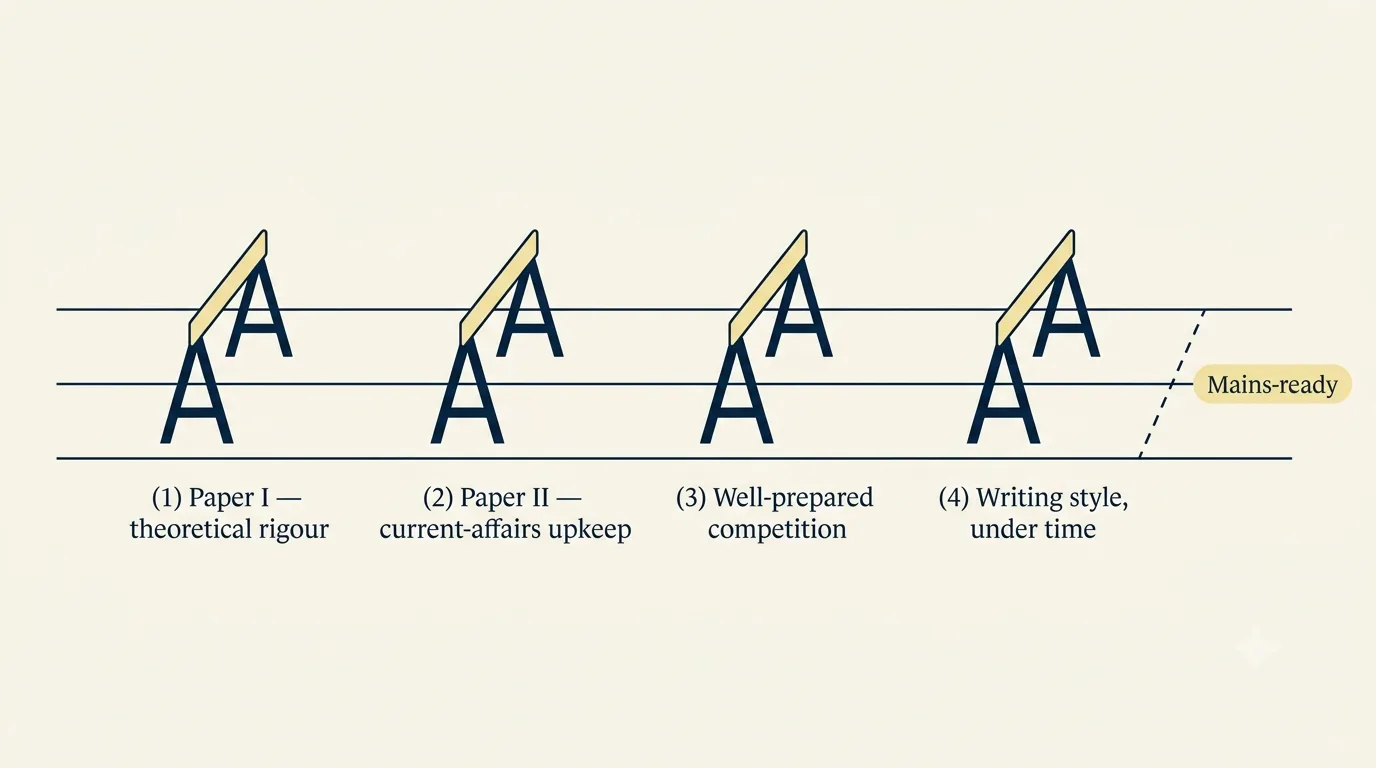
The four honest concerns
In order of how much they should worry you.
1. Paper I is theoretically demanding
Paper I asks for real theory. Micro, macro, international economics, public finance and growth are covered rigorously. For MA Economics students, most of this is familiar. For BA students it is doable, but not casual. For a non-Economics student, the climb is real — possible, but not a low-effort choice. If you plan to take Economics optional as a non-Economics graduate, budget at least 6–9 months of pure conceptual building before you start writing answers seriously.
2. Paper II has an ongoing maintenance cost
Some optionals are largely static — History, Literature, Philosophy. Economics Paper II (Indian Economy) is not. The Union Budget, Economic Survey, RBI monetary policy statements, sectoral data releases, new schemes, ministry-level notifications — you have to stay current, and the “current” horizon extends right up to the exam.
The saving grace: if you are preparing UPSC seriously, you are anyway reading economy current affairs for GS Paper III. It is a discipline extension, not a separate burden. But it is a cost worth acknowledging up front, especially in the final six months when integrating theory with the latest data matters most.
3. The competition is well-prepared
Economics optional attracts trained candidates — DSE, JNU, ISI, IGIDR and JMI postgraduates, IITs with Economics minors, ex-finance and ex-policy candidates. The average quality of answers is high. Examiners can tell the difference between someone who understands the subject and someone who has memorised notes. This is not meant to scare you; it is meant to set the standard. If you were the strongest Economics student in your college, that was a nice signal — it is not the exam benchmark.
4. It requires a specific writing style
Economics optional rewards students who can construct structured arguments, apply theory to Indian policy, and draw correct labelled diagrams under exam-time pressure. These are learnable skills — but if your natural strength is narrative recall rather than analytical construction, factor in the writing-practice cost before you commit. Two hours of daily writing practice, 5–6 days a week, for at least the last four months, is not an aggressive target. It is the baseline.
The three-question decision test
Sit with these before you finalise the optional.
Question 1 — What is your Economics background?
- MA Economics. Serious consideration. Not automatic — you still have to convert into UPSC-style answers — but the concept base is strong and Paper I is largely a rigour test on ground you have already walked.
- BA Economics. You have a base. Do not be scared, do not be casual. Expect a solid 6 months of concept-building before serious answer writing.
- No Economics background. Consider it only if you genuinely like the subject and have the time to build the foundation. Rushed prep with a weak foundation is the fastest way to a poor score. Another optional may serve you better.
Question 2 — Are you also considering IES or RBI Grade B DEPR?
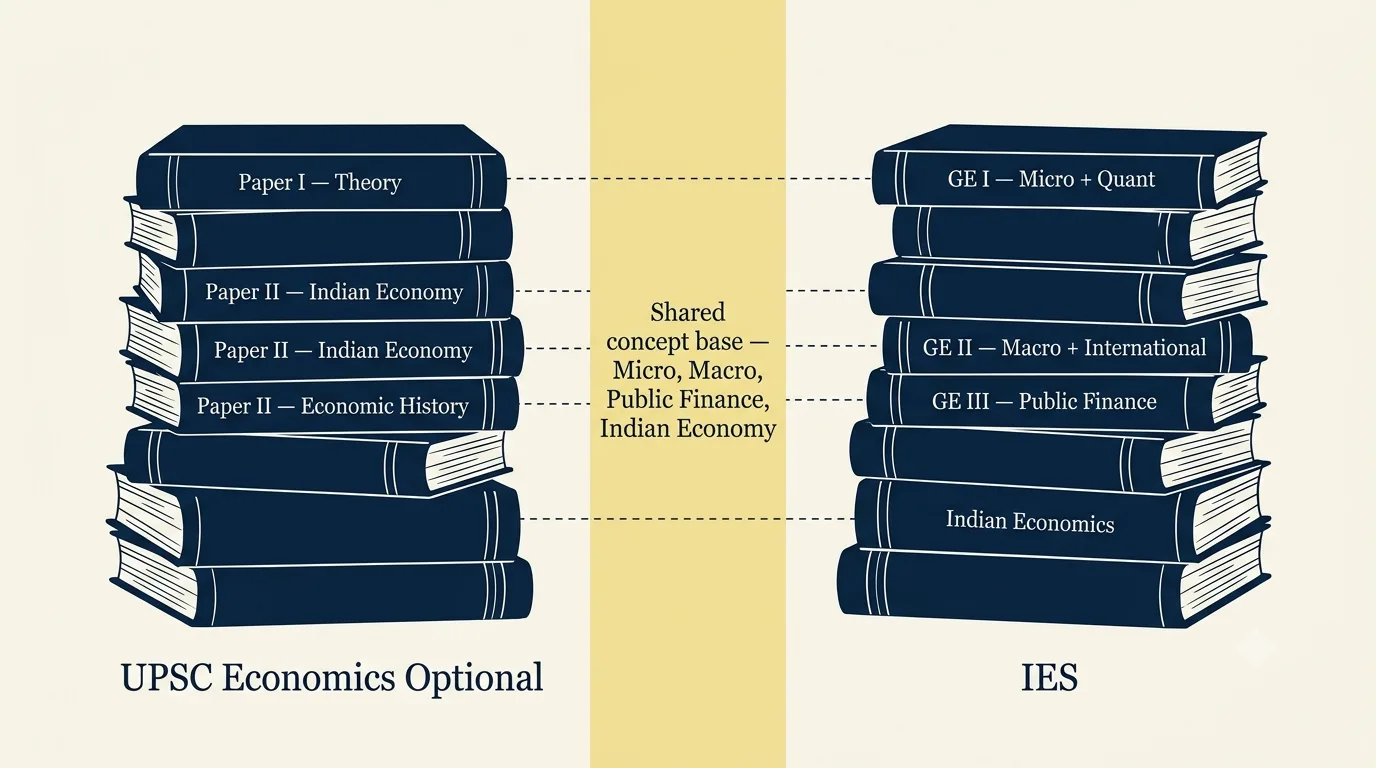
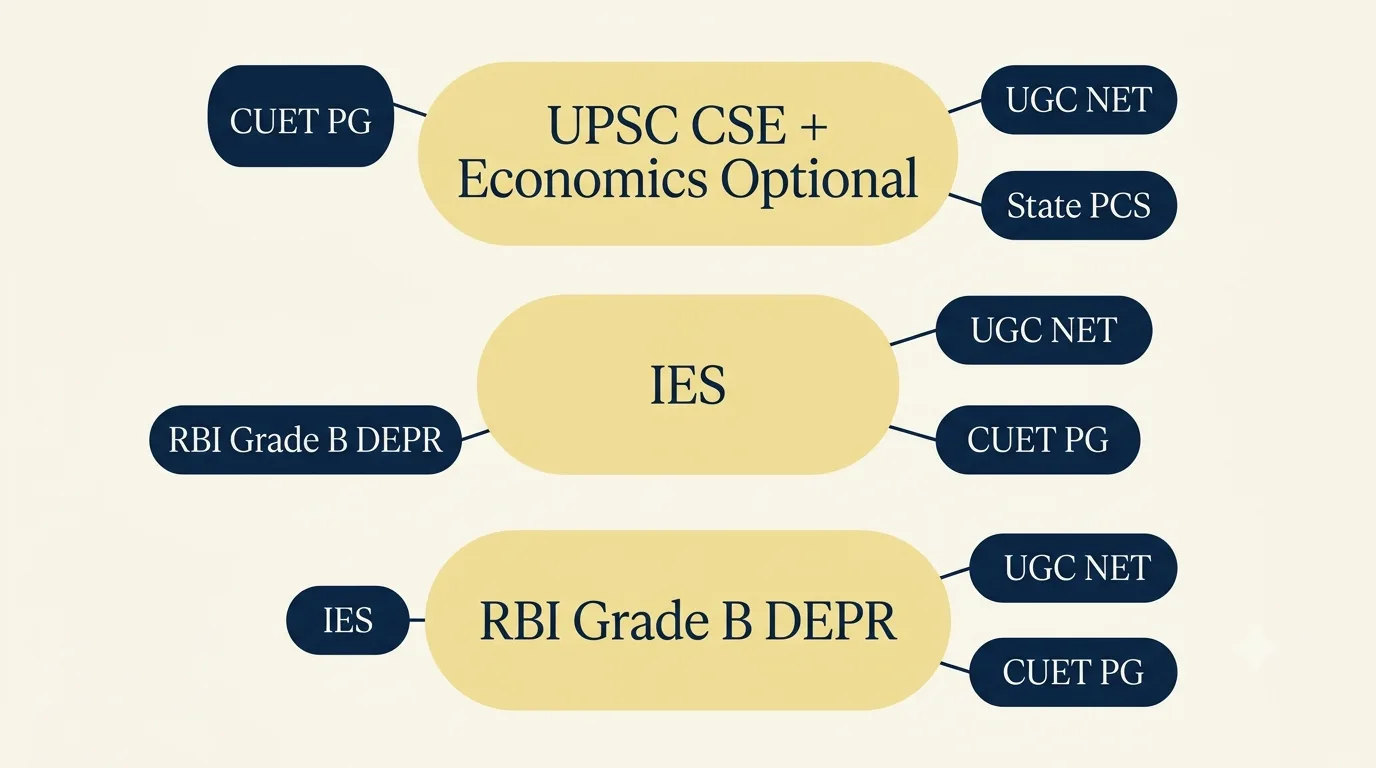
If yes — Economics optional becomes strategically coherent. IES, RBI DEPR and Economics optional share a large concept base. Post 8 walks through the IES–Optional overlap table in detail; Post 11 does the same for DEPR against IES.
Note: this argues for taking Economics optional if IES or DEPR is your Plan B. It does not argue for preparing for all three simultaneously from day one. See the backup cluster strategy for how a real cluster is structured.
Question 3 — Can you write analytical answers under pressure?
The most underrated question. A 20-mark Mains answer has to be written in about ten minutes and needs a real structure — definition, theory, correctly labelled diagram (where relevant), application to India, critical evaluation. If you have done mock writing and can hold that structure under time pressure, that is a strong signal. If you go blank under time pressure, that is fixable — but fix it early, not the week before Mains.
Four preparation principles
These are what separates the students who convert their concept base into a rank.
- Concept clarity first, then answer writing. Both matter, but in that order. Answer writing built on shaky concepts collapses under examiner scrutiny; concepts without answer-writing practice never make it onto the page in the time allotted.
- PYQs from Day 1. Look at what UPSC actually asks before you finalise your preparation plan. The examiner’s preferences are printed in the last ten years of papers — how questions are phrased, what they test, what a good answer looks like structurally.
- Diagrams are non-negotiable. A correct, cleanly labelled diagram in a Micro or Macro answer visibly improves your score. Practise them under time pressure until they are automatic — indifference curves, IS-LM, AS-AD, Laffer, Ricardian equivalence.
- Integrate current affairs into theory. The Economic Survey 2025-26 and Union Budget 2026-27 are not extra reading — they are the case studies your theoretical framework should be predicting. Every scheme you read, every fiscal number you note, should attach to a theoretical concept you are already preparing.
Takeaway. Economics optional is not for everyone. It is for the student who has an Economics base (or the appetite to build one honestly), can write structured analytical answers under pressure, and either wants to use Economics deeply on the job or has IES / DEPR as a coherent Plan B. If that describes you, the concerns above are climbs, not walls.
Sources and further reading
- Union Public Service Commission — upsc.gov.in: CSE Notification and Economics Optional syllabus.
- UPSC Annual Reports — upsc.gov.in/annual-report: candidate counts by optional subject.
- Economic Survey — indiabudget.gov.in/economicsurvey: the primary reference for Paper II Indian Economy current affairs.
- Union Budget — indiabudget.gov.in: fiscal-side reference for Paper II.
- Reserve Bank of India — rbi.org.in: Monetary Policy Reports for money-and-banking portions.
On EcoNiti
- UPSC CSE Economics Optional at EcoNiti — exam profile, syllabus map and our concept-first preparation approach.
- UPSC Economics Optional coaching — see what the course covers, watch Dr. Komal’s teaching preview and check the fee before deciding.
You can speak to us about your preparation if you are unsure whether a full course would help. If cost is holding you back, ask about the Scholars Programme. Financial support is considered after application.
Questions students ask
Is Economics a good UPSC CSE optional if I don't have an Economics background?
Consider it only if you genuinely like the subject and have the time — a solid 6–9 months of concept-building before serious answer writing. Rushed prep with a weak foundation is the fastest way to a poor score. Another optional may serve you better.
Do you need to draw diagrams in the UPSC Economics optional paper?
Yes. A correct, cleanly labelled diagram — indifference curves, IS-LM, AS-AD, Laffer, Ricardian equivalence — visibly improves your score in Micro and Macro answers. Practise them under time pressure until they are automatic.
How much current affairs does the UPSC Economics optional Paper II require?
Paper II covers Indian Economy and needs continuous current-affairs work — Union Budget, Economic Survey, RBI Monetary Policy Reports, sectoral data, new schemes. If you are preparing UPSC seriously you are already reading this material, so it is a discipline extension rather than a separate burden.