If you are preparing UPSC CSE with Economics optional, or preparing IES with UPSC as a possible expansion later, one question keeps coming back: how much of my preparation is genuinely shared?
The short answer: a lot. The longer answer needs a table. This post lays out the overlap between the IES syllabus and the UPSC Economics Optional syllabus, works through the four-question framework applied specifically to a joint IES–Optional strategy, and closes with the four preparation principles that hold across both.
The overlap, on one page
Swipe sideways to see all columns.
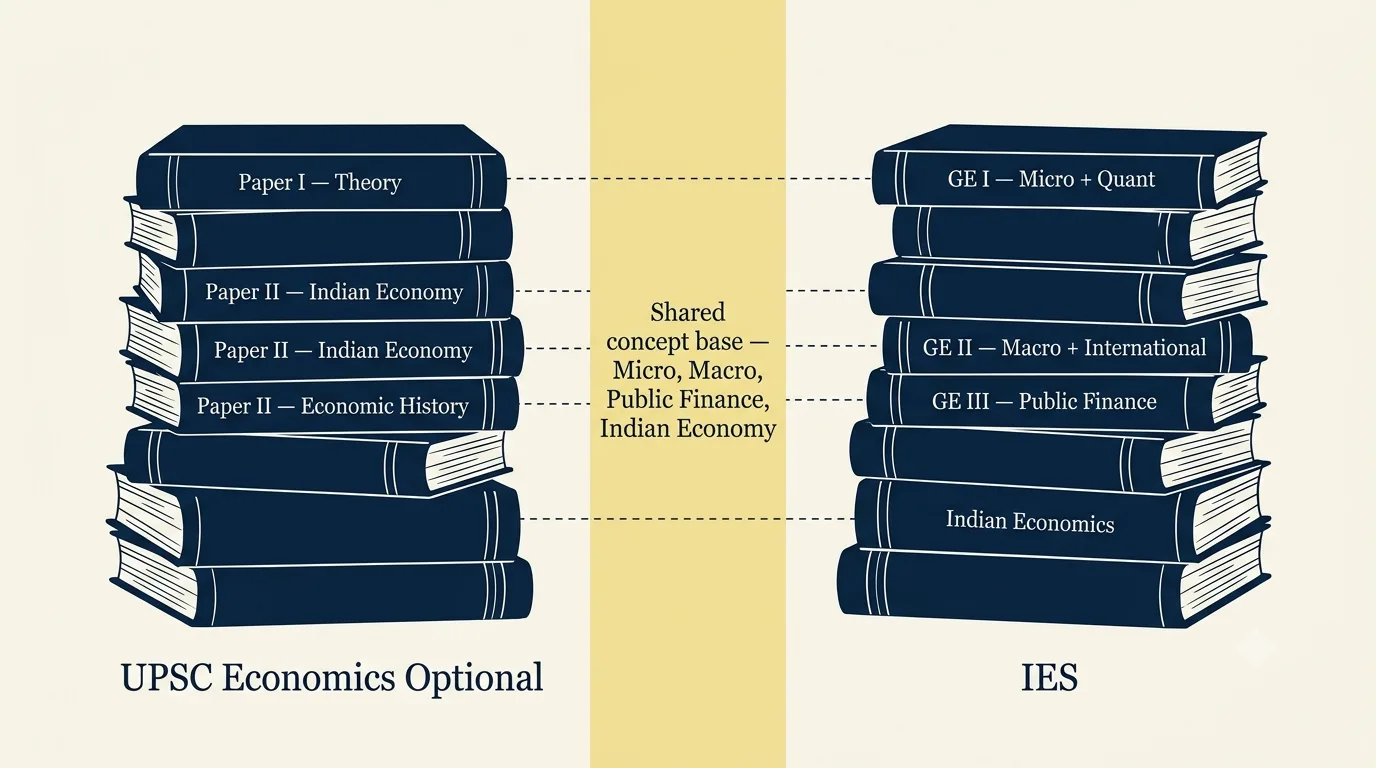
| Topic area | IES paper | UPSC Economics Optional |
|---|---|---|
| Microeconomics | GE I | Paper I |
| Macroeconomics | GE II | Paper I |
| Public Finance | GE III | Paper I |
| International Economics | GE II | Paper I |
| Growth & Development | GE II | Paper I & II |
| Indian Economy (contemporary) | Indian Economics | Paper II |
| Advanced Microeconomics | GE I | Not in Optional |
| Statistics & Econometrics | GE I | Not in Optional |
| Mathematical Methods, LPP | GE I | Not in Optional |
| Financial Markets | GE II | Not in Optional |
| Industrial Economics | GE III | Not in Optional |
| History of Economic Thought | GE II | Not in Optional |
| Environmental Economics | GE III | Partial |
| Economic History of India | Not in IES | Paper II |
Reading the table honestly:
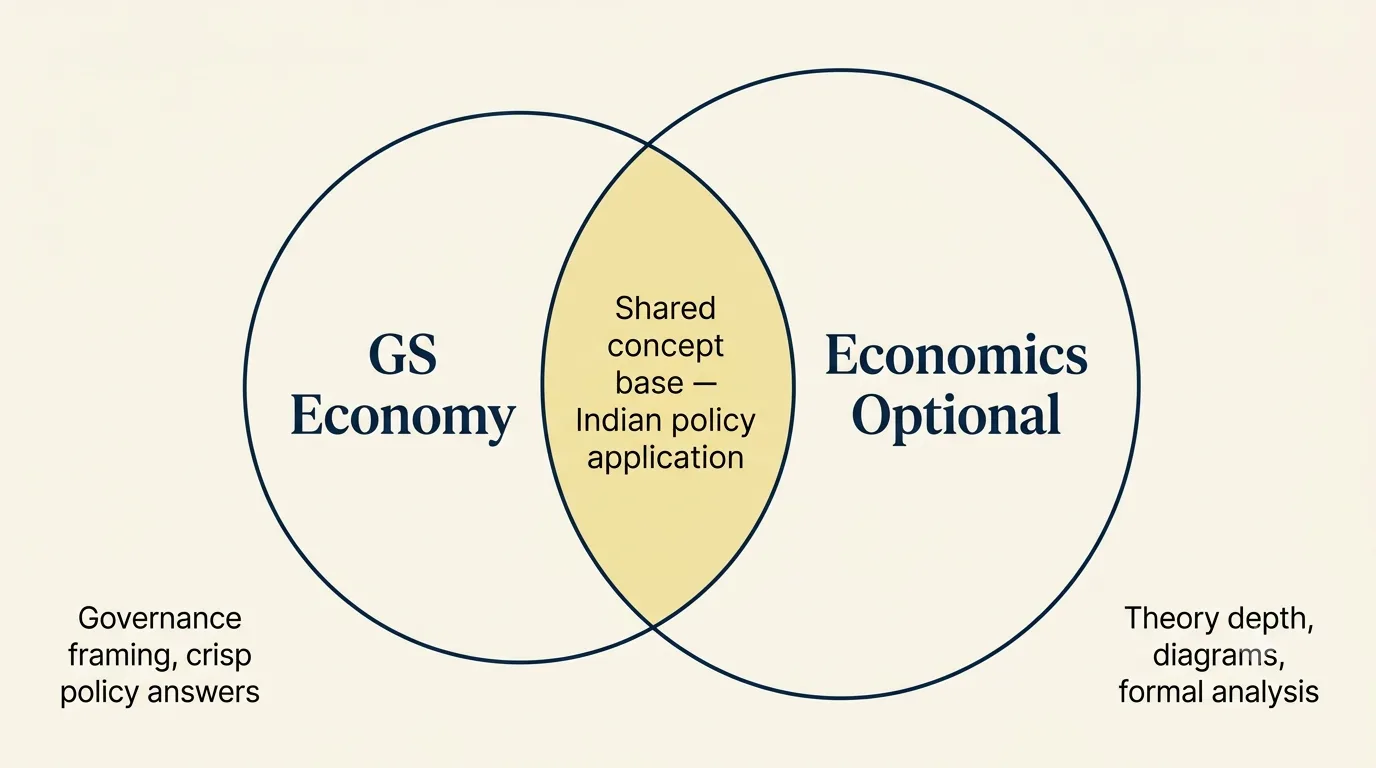
What overlaps almost fully. Microeconomics, Macroeconomics, Public Finance, International Economics, Growth & Development, and Indian Economy — six of the biggest topics, present in both exams with substantially the same theoretical base.
What IES asks that Optional does not. Advanced Micro (game-theoretic depth), Statistics + Econometrics, Mathematical Methods and LPP, Financial Markets, Industrial Economics, and History of Economic Thought. These are additional preparation for IES, not for Optional — but they are also topics your MA Economics coursework has likely partially covered.
What Optional asks that IES does not. Economic History of India (Paper II Section A) is a specific Optional bucket that does not carry over.
The practical implication: if you are seriously preparing for IES, a large part of the UPSC Economics Optional foundation gets built as a by-product. If you have already prepared for Optional, the conversion to IES prep is meaningful and faster — you have the concept base; you are adding the extra topics and adjusting the writing style.
The four-question framework, applied to a joint strategy
1. Time horizon
- Two clear years ahead. Optional as part of UPSC + IES as the sharper backup is realistic. Your first serious IES attempt slots into an inter-Prelims window.
- One year or less. Choose one. Attempting both without the runway usually means a poor Optional score and an under-prepared IES paper.
2. Risk tolerance
- Low. IES-primary with Optional prepared “along the way” is the more predictable strategy — IES has a shorter cycle, defined pool, and clearer conversion pattern.
- Higher. UPSC-primary with Optional and IES as backup expands the upside but pushes decision fatigue up. Both structures are defensible.
3. Genuine interest
If your instinctive reading is Economic Survey and RBI publications, both exams reward you. If your instinctive reading is polity, governance and international relations, UPSC-primary with Optional is a natural home; IES is a rational backup rather than a co-primary.
4. Job suitability
Both roles are analytical, writing-heavy, institutional. If that matches your temperament, the joint strategy is coherent. If your preferred day is field-facing (District Collector, ambassadorial roles), UPSC is primary and IES is a hedge, not a partner.
A joint-strategy blueprint
Assume a 24-month runway. This is illustrative, not prescriptive.
- Months 1–6. Concept clarity across Micro, Macro, Public Finance, International, Growth. These are your shared foundation. Read the Optional syllabus and the IES syllabus side by side; mark the additional IES topics (Statistics, Econometrics, Math Methods, LPP, Financial Markets, Industrial, History of Thought) for a dedicated pass.
- Months 7–12. Additional IES topics + start structured answer writing for Optional-style questions. PYQ pass on both exams. Begin Indian Economy current affairs alongside — Economic Survey and Union Budget.
- Months 13–18. If IES is coming up first, shift weight to IES-style descriptive answers, six papers under simulated timing. Otherwise, deepen Optional answer writing while keeping IES topics on maintenance.
- Months 19–24. Whichever exam is next, ~10 weeks of exclusive focus and simulated papers. The other exam stays alive on light maintenance — you have already banked the concept base.
The trap this blueprint is built to avoid: 24 months of “50-50 IES-Optional prep” that ends with neither exam converted. Focus rotates by phase; the split is not maintained at every point in time.
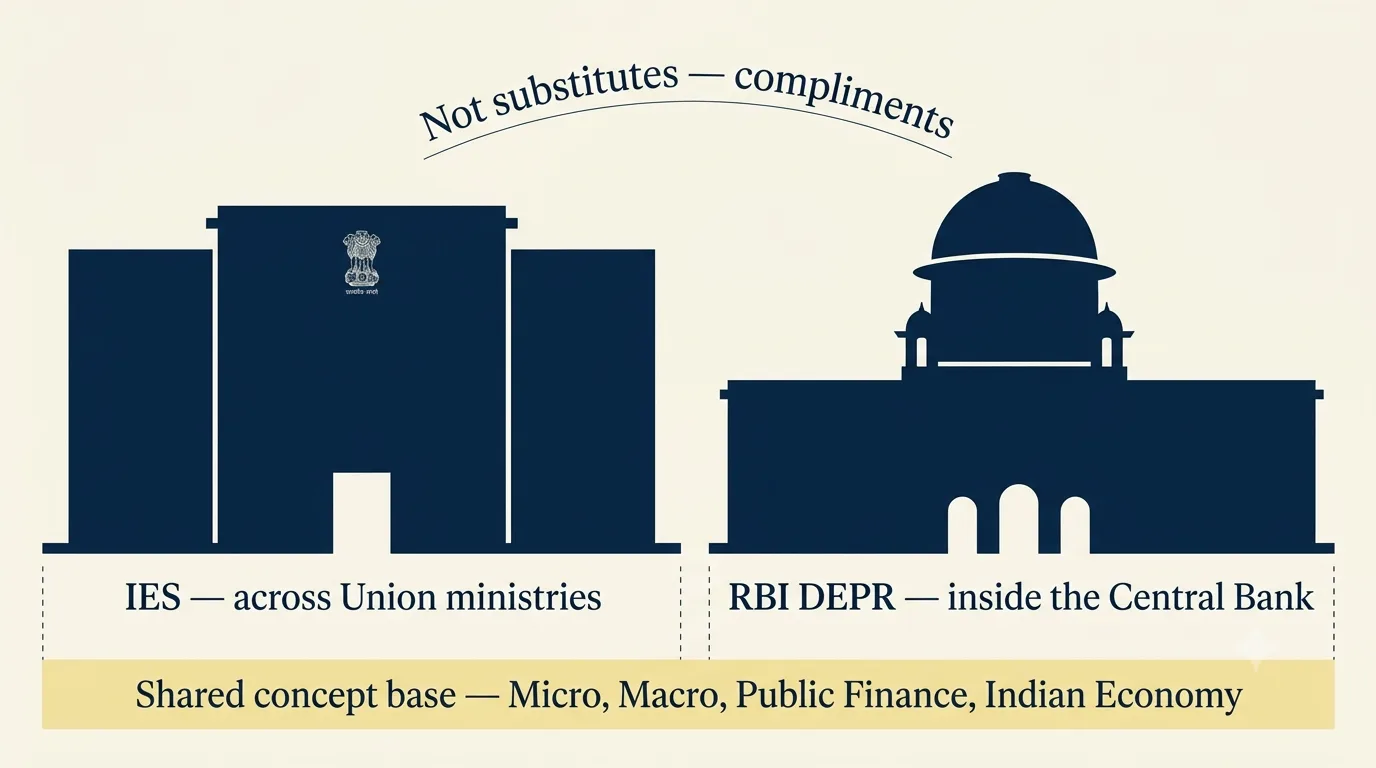
For the wider backup logic across all three exams (UPSC CSE, IES, RBI DEPR), see Post 3 — the backup cluster strategy.
Four preparation principles that hold for both
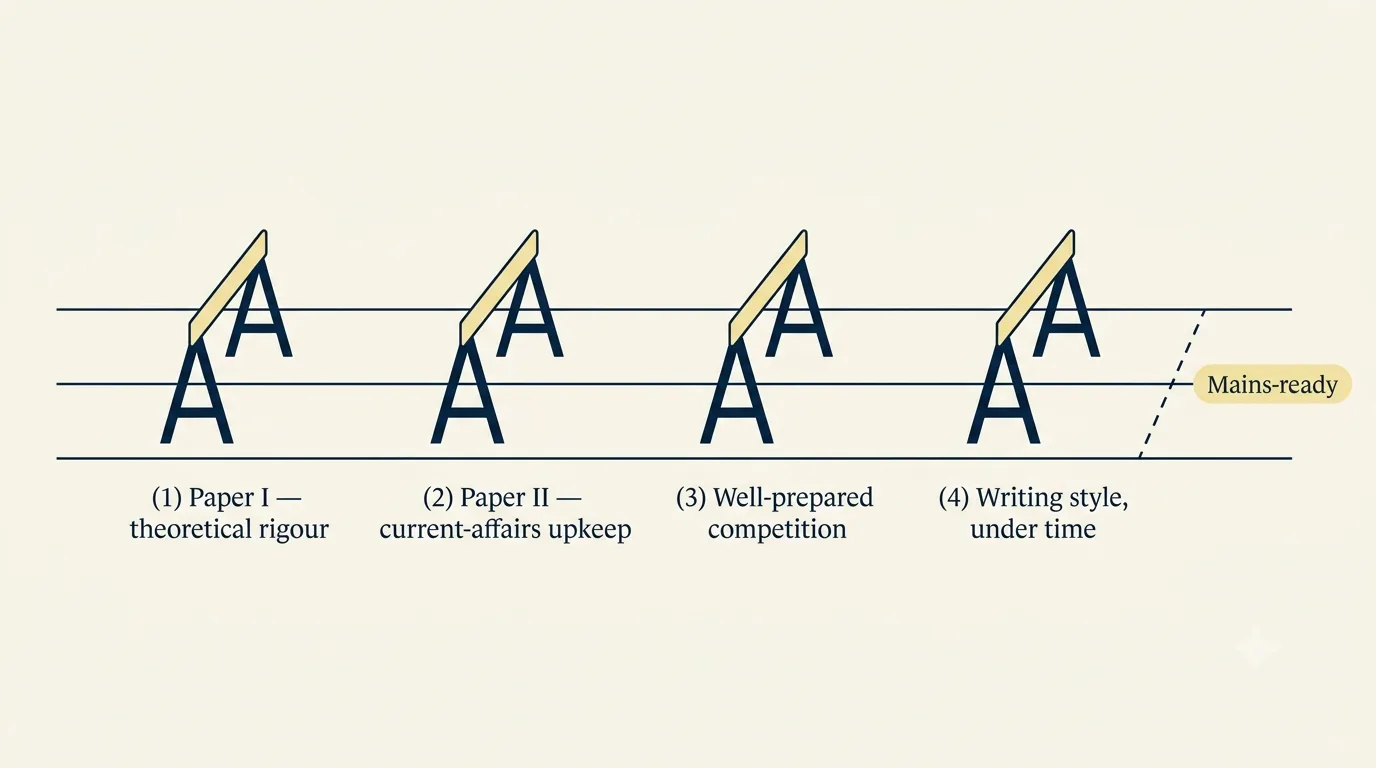
- Concept clarity first. The examiner knows Economics. Familiarity is not enough; rigour is.
- PYQs from Day 1. Understand what each exam actually asks before you build the plan. IES and Optional PYQs together give you the register both exams reward.
- Descriptive answer writing from Month 1. Knowing theory and writing theory are two different skills — diagrams, frameworks, Indian examples, structured arguments.
- Integrate theory with current affairs. Both exams reward the student who can place the Economic Survey inside a theoretical framework — not the one who catalogues it.
Takeaway. IES and UPSC Economics Optional share a substantial concept base — enough that a joint strategy is realistic if you have the runway and the temperament. Do not treat them as two independent projects; treat them as one Economics rigour project with two exam-specific finishing modules.
Sources and further reading
- Union Public Service Commission — upsc.gov.in: CSE Notification, IES / ISS Notification and both syllabi.
- Ministry of Finance, Department of Economic Affairs — dea.gov.in.
- Economic Survey and Union Budget — indiabudget.gov.in: the Indian Economy anchor for both exams.
- Reserve Bank of India — rbi.org.in: Monetary Policy Reports for money-and-banking depth.
On EcoNiti
- UPSC CSE Economics Optional at EcoNiti — exam profile and our Optional preparation track.
- Indian Economic Service at EcoNiti — exam profile and our IES preparation track.
Questions students ask
How much overlap is there between the IES syllabus and UPSC Economics Optional?
A large one. Microeconomics, Macroeconomics, Public Finance, International Economics, Growth & Development and Indian Economy — six major topic areas — appear in both. IES additionally tests Advanced Micro, Statistics, Econometrics, Mathematical Methods, LPP, Financial Markets, Industrial Economics and History of Economic Thought.
Can I prepare for IES and UPSC Economics Optional together?
Yes, if you have a two-year runway. Build the shared concept base first (Months 1–6), add the IES-only topics (Months 7–12), then rotate focus by phase to whichever exam is next. Attempting both without runway usually means an under-prepared IES paper and a poor Optional score.
Should I take Economics as UPSC optional if I want to appear for IES later?
Yes — the two exams share the majority of their concept base, so Economics optional preparation double-purposes as IES foundation. The extra IES-only topics (Statistics, Econometrics, Industrial, History of Thought) become a targeted second pass rather than a fresh start.