This article explains what each IES paper tests and how to prepare for it. If you are new to the exam, start with the Indian Economic Service guide for eligibility, selection and preparation options. You can also read about the work of an IES officer.
For dates, vacancies, eligibility cut-offs and relaxations, check the UPSC notification for your attempt.
Eligibility, age and seats
Per the annual UPSC IES / ISS Notification:
Swipe sideways to see all columns.
| Criterion | Typical requirement |
|---|---|
| Educational qualification | Postgraduate degree in Economics / Applied Economics / Business Economics / Econometrics from a recognised university |
| Age (unreserved) | 21–30 as on the notification’s cut-off date; standard category relaxations apply |
| Vacancies | Small — typically single-digit to low double-digit; verify the exact current-cycle count |
| Exam conducting body | Union Public Service Commission |
| Typical exam window | Mid-June |
For BA Economics and MA students: a bachelor’s degree alone does not qualify you. Candidates awaiting their qualifying result or appearing in the qualifying examination may apply provisionally under UPSC’s conditions, but must submit proof of passing by the required deadline. Simply being in the first year of an MA does not make you eligible. For practice before you qualify, attempt past papers at home under exam conditions.
IES is a specialist examination: your postgraduate economics training is directly relevant to what it tests. That makes it worth considering seriously even though the vacancy count is small. Compare the syllabus with what you have already studied, then plan for the remaining subjects and written practice.
The exam pattern
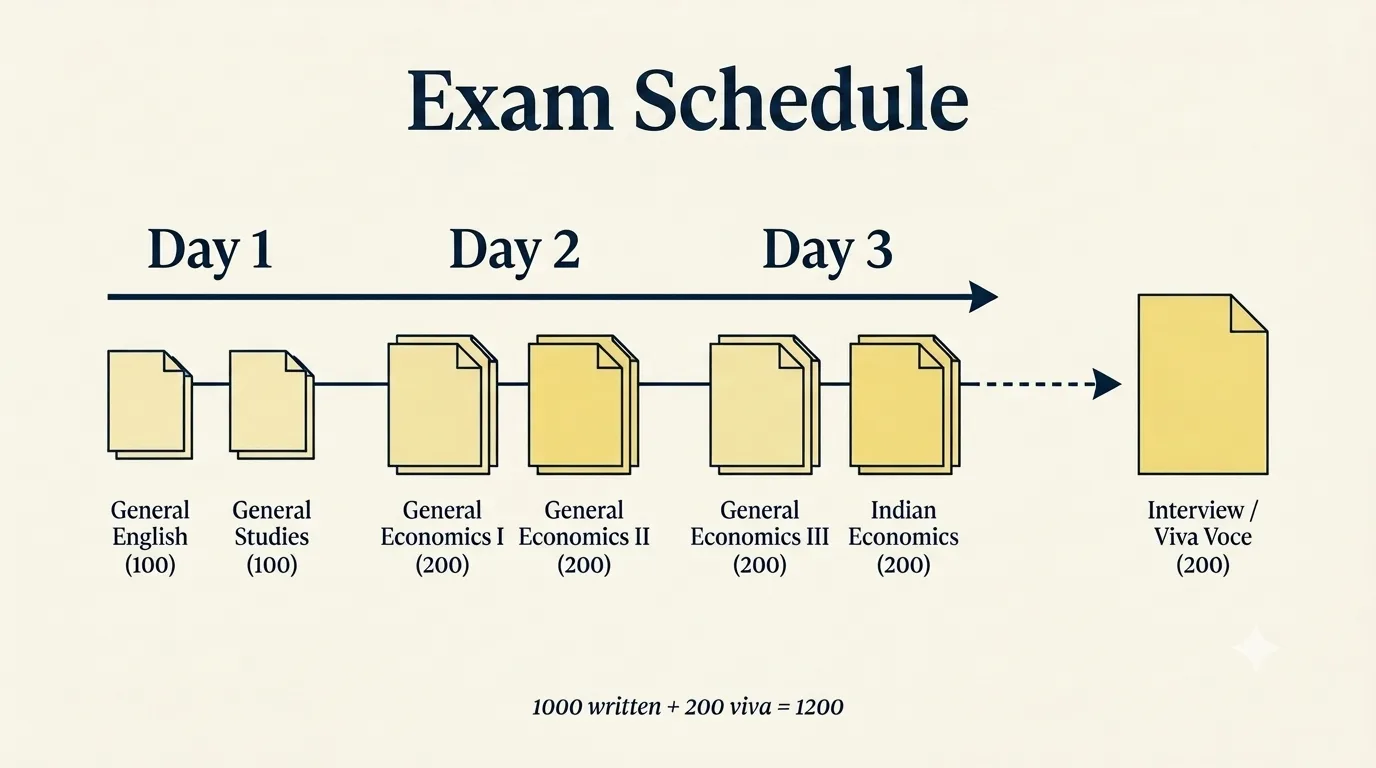
IES selection is two stages — a written examination (1000 marks) and an interview / viva voce (200 marks). There is no MCQ phase.
Swipe sideways to see all columns.
| Paper | Marks | Day |
|---|---|---|
| General English | 100 | Day 1 |
| General Studies | 100 | Day 1 |
| General Economics I | 200 | Day 2 |
| General Economics II | 200 | Day 2 |
| General Economics III | 200 | Day 3 |
| Indian Economics | 200 | Day 3 |
| Written total | 1000 | |
| Interview / Viva Voce | 200 | Post-shortlisting |
| Grand total | 1200 |
Three structural facts worth pulling out.
IES is a writing exam. No MCQ shortcuts. You need to know Economics — and you need to be able to express Economics in structured, timed, hand-written form. The candidate whose head is full of concepts but whose hand cramps after two answers will not clear.
English and GS carry 200 marks together. Not decisive, but not ignorable either. A candidate who is strong in Economics and average in English/GS will beat one who is strong in Economics and weak in English/GS — the difference plays out at the margin.
Interview is 200 out of 1200 — one-sixth of your total. It carries the same marks as one economics paper. Prepare for it seriously by explaining your reasoning aloud and discussing current economic issues, rather than leaving it entirely to the last few weeks.
Syllabus — the four buckets
The full official syllabus is in the UPSC IES / ISS Notification. What follows is the logic of each paper — what each is really testing, and how the four buckets map to your preparation.
General Economics I — Micro plus Quantitative
Micro: consumer demand theory, production and cost theory, market structures, price theory, welfare economics, factor markets, distribution. Market-failure Public Economics (externalities, public goods, asymmetric information) sits here. Plus game theory basics.
Quantitative: mathematical methods for Economics, Linear Programming, statistics, regression analysis, time series, index numbers, and econometric issues (heteroskedasticity, autocorrelation, multicollinearity).
If you are coming from an MA Economics background, Micro is largely familiar; the quantitative half is where most candidates need to close a gap. Diagrams and derivations must be automatic.
General Economics II — Macro, Money, International, Growth, History of Thought
Macro: national income, employment, output, inflation, money, IS-LM, Mundell-Fleming, money and capital markets.
Growth and Development: growth theories, development economics, poverty, inequality.
International: trade theories, balance of payments, exchange rates, IMF, World Bank, WTO, G20.
History of Economic Thought: the major schools and thinkers.
Paper II is the widest paper in scope but the most rewarding structurally — a well-organised answer that connects a theoretical framework to a piece of Indian macro data lifts a mediocre-looking response into a scoring one.
General Economics III — Public Finance, Environment, Industrial
Public Finance: taxation theory, tax structure, public expenditure, public debt, cost-benefit analysis. The state–market–planning debate lives here too.
Environmental Economics: valuation, values, policy instruments.
Industrial Economics: industrial policy, competition, market structure, industry dynamics.
Paper III is where a student with an MA Public Economics elective is at their most comfortable. Environment and Industrial are the two portions where many candidates underprepare — worth a specific pass instead of a “read later” bucket.
Indian Economics — India’s Development Story
From the planning era through the 1991 reforms and into post-reform India: federal finance, Union Budget, poverty measurement, unemployment, agriculture, rural development, urbanisation, infrastructure, labour markets, foreign trade, money and banking, and inflation in the Indian context.
This paper connects directly to current affairs — the latest Economic Survey, Union Budget and RBI reports are the primary references. Use the editions relevant to your attempt.
Use a relevant example or a recent official figure when it supports your argument. State its source and year. An unrelated statistic does not improve an answer, and you should never invent one.
Takeaway. IES’s structure rewards depth and structured writing across four durable buckets — Micro+Quant, Macro+International+Growth, Public Finance+Industrial+Environment, and Indian Economics. Master the paper-by-paper logic first, then convert into timed writing. That is the shortest realistic route to a competitive score.
Sources and further reading
- Union Public Service Commission — upsc.gov.in: IES / ISS Notification and syllabus are the only authoritative sources for current-cycle vacancies, exam dates and syllabus.
- Ministry of Finance, Department of Economic Affairs — dea.gov.in: parent ministry of the IES cadre.
- Institute of Economic Growth, Delhi — iegindia.org: IES officer training academy.
- Economic Survey — indiabudget.gov.in/economicsurvey: use the latest edition relevant to your attempt.
- Union Budget — indiabudget.gov.in: primary reference for public finance and Indian Economics current affairs.
Papers, classes and evaluated practice
- Free IES previous year papers to practise the topics you have studied.
- IES + RBI DEPR coaching if you need economics classes with Dr. Komal, tests and evaluation. IES General Studies and English are outside this course.
- IES Answer Writing Programme if you already know the syllabus and need revision and evaluated practice, including General Studies and English.
Not sure which you need? Tell us what you have studied so far. If fees are a concern, ask about the Scholars Programme before deciding against applying.