Every Economics student in India knows about UPSC CSE. Many now know about RBI Grade B. Fewer talk about the exam that was literally designed for Economics graduates: the Indian Economic Service (IES).
IES is the specialist government-economist cadre of the Government of India — a Group A Central Service under the Department of Economic Affairs, Ministry of Finance. Its officers work across the Union ministries and departments where India’s economic policy actually gets shaped. This post covers what IES is, why I call it a hidden gem, and the deputation ladder that makes the career shape unusually rich. The exam pattern, syllabus and overlap with the UPSC Economics Optional are in the two follow-up posts.
For qualifications, the selection process and where to begin, use the Indian Economic Service exam guide. This article focuses on the career itself.
Three confusions to clear first
Confusion 1 — IES vs “IES Engineering”. UPSC’s Engineering Services Examination is also called “IES” by some. That is a different exam and a different cadre. This post is entirely about the Indian Economic Service.
Confusion 2 — IES is not IAS with an Economics paper. IAS is a generalist administrative service; IES is a specialist Economics service. Different exam, different work, different daily life.
Confusion 3 — IES is not ISS. UPSC issues a combined “IES / ISS” notification, but the Indian Economic Service and the Indian Statistical Service are separate cadres with different qualifications. IES requires a specified postgraduate economics degree; a BA alone is not enough.
What IES actually is
- A Group A Central Service under the Department of Economic Affairs, Ministry of Finance.
- Established in 1961, following an idea originally from Jawaharlal Nehru’s cabinet.
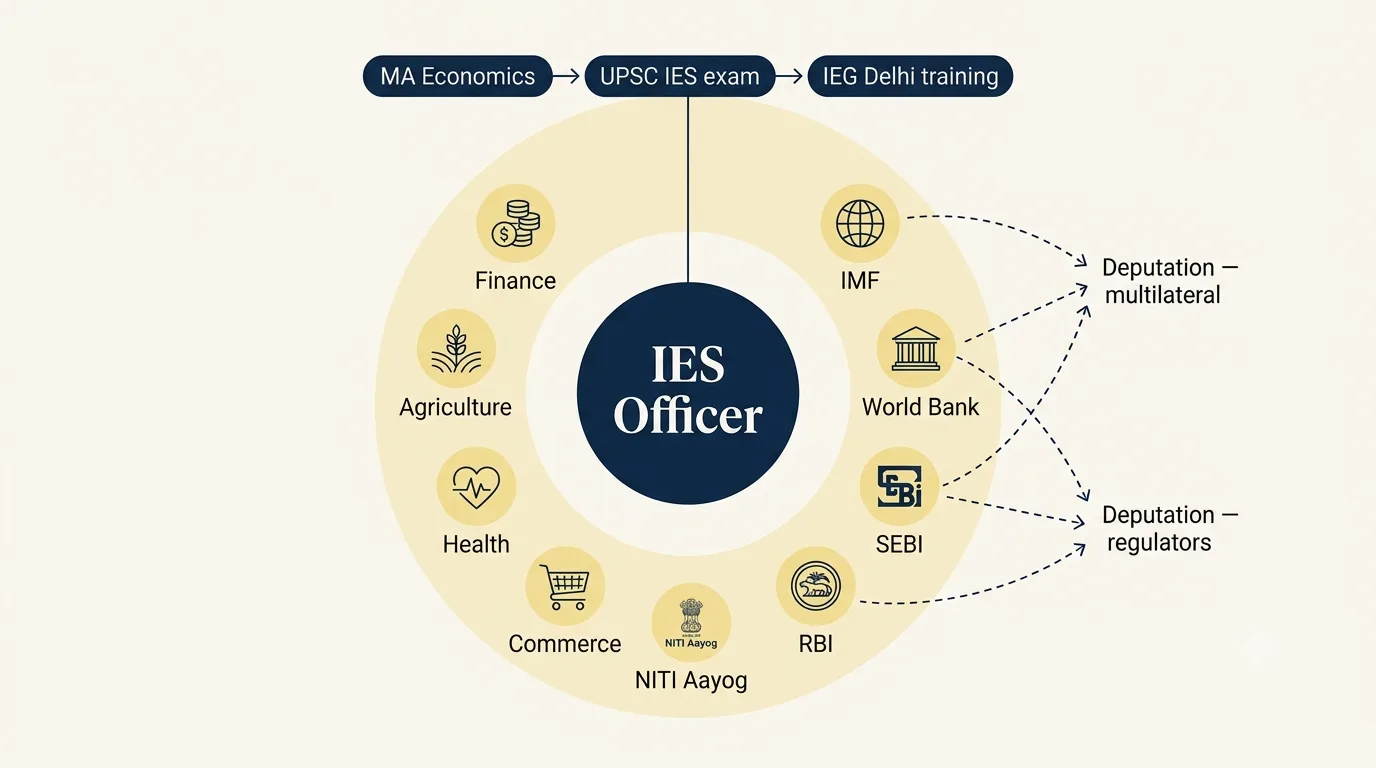
- Officers are trained at the Institute of Economic Growth (IEG), Delhi — the same IEG that houses one of India’s oldest research institutions in Economics.
- Structurally an inter-ministerial service: an IES officer’s cadre postings span across the Union ministries — Finance, Agriculture, Education, Health, Environment, Energy, Industry, Rural Development, Commerce, Planning and many more.
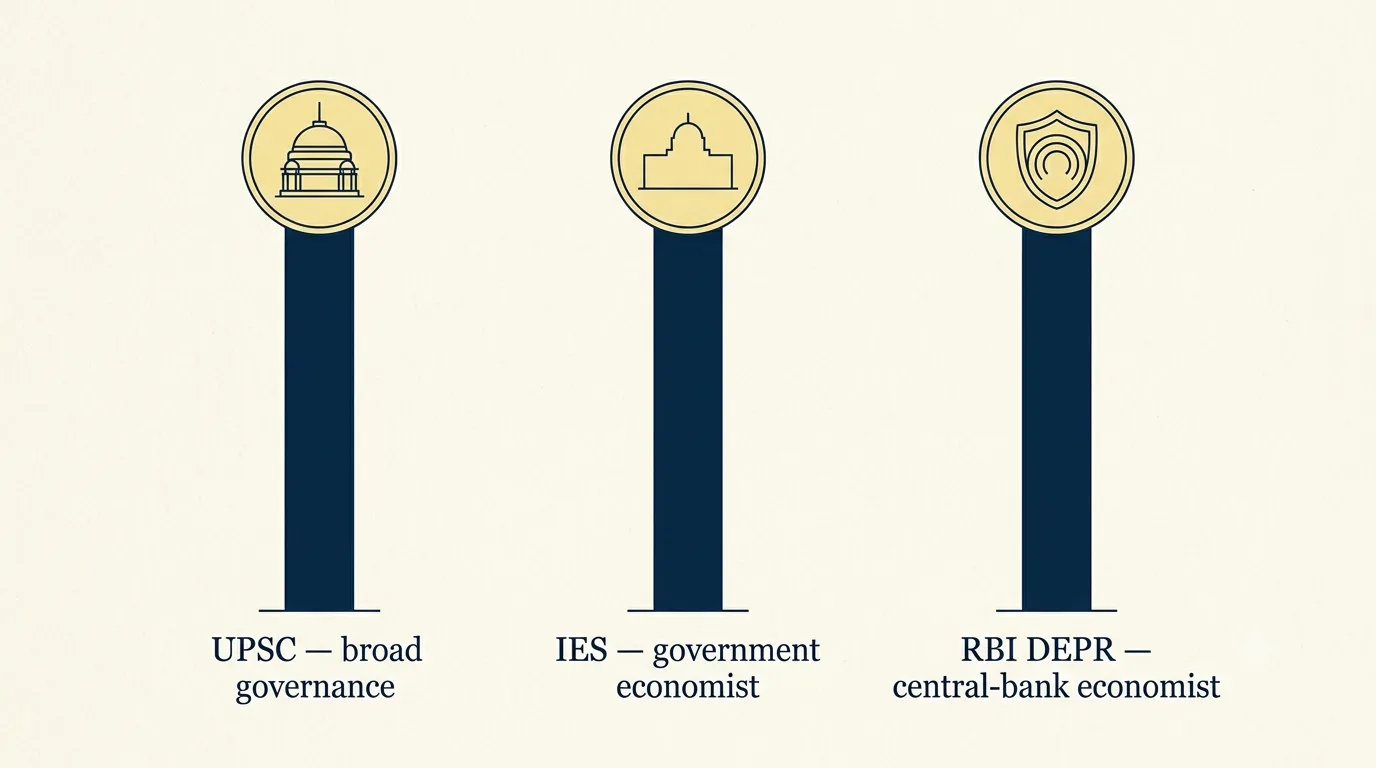
In one line: UPSC CSE creates administrators. IES creates government economists.
Why I call it a hidden gem
Not because it is obscure — the notification is public and widely covered — but because Economics students routinely fail to seriously consider it. Three reasons it deserves that consideration:
- Government stability. A Group A permanent service, with central-government pay, benefits, security and housing.
- Policy relevance. You are working at the core of India’s policy system — Budget preparation, scheme design, sectoral reforms, economic analysis — as your actual job, not as background reading you did in college.
- Daily use of Economics. In IES, Economics is not a paper you cleared. Economics is the job. Every day.
Very few careers combine those three at once. That is the hidden-gem case.
Deputation — the career multiplier
Deputation means temporarily serving outside your parent cadre while remaining an IES officer. Over a career, an IES officer’s deputation options can include:
- Multilateral institutions — World Bank, IMF, Asian Development Bank, UN agencies.
- Domestic regulators — RBI, SEBI, TRAI, and others where economic expertise is directly needed.
- State governments — for fiscal reforms, sectoral strategy, outcome budgeting support.
- Foreign governments — bilateral economic advisory roles.
- Think tanks and research institutions — policy research assignments.
For a concrete example of this range, the official service record of Srinivasa Rao N. includes work in Andhra Pradesh’s Finance Department, the Ministry of Agriculture, the insurance regulator and the Department of Economic Affairs. It shows how an IES career can connect economic analysis with budgeting, regulation and policy across institutions.
Who IES fits
If you are in MA Economics, or about to begin one, and any of the following describe you — IES belongs on your list:
- You want a stable Group A government career where the daily work is Economics itself.
- You are drawn to fiscal policy, public finance, development economics, scheme design, sectoral reforms.
- You prefer analytical, reading- and writing-heavy work over field-facing administration.
- You want a career arc that could plausibly take you through multilateral institutions and back.
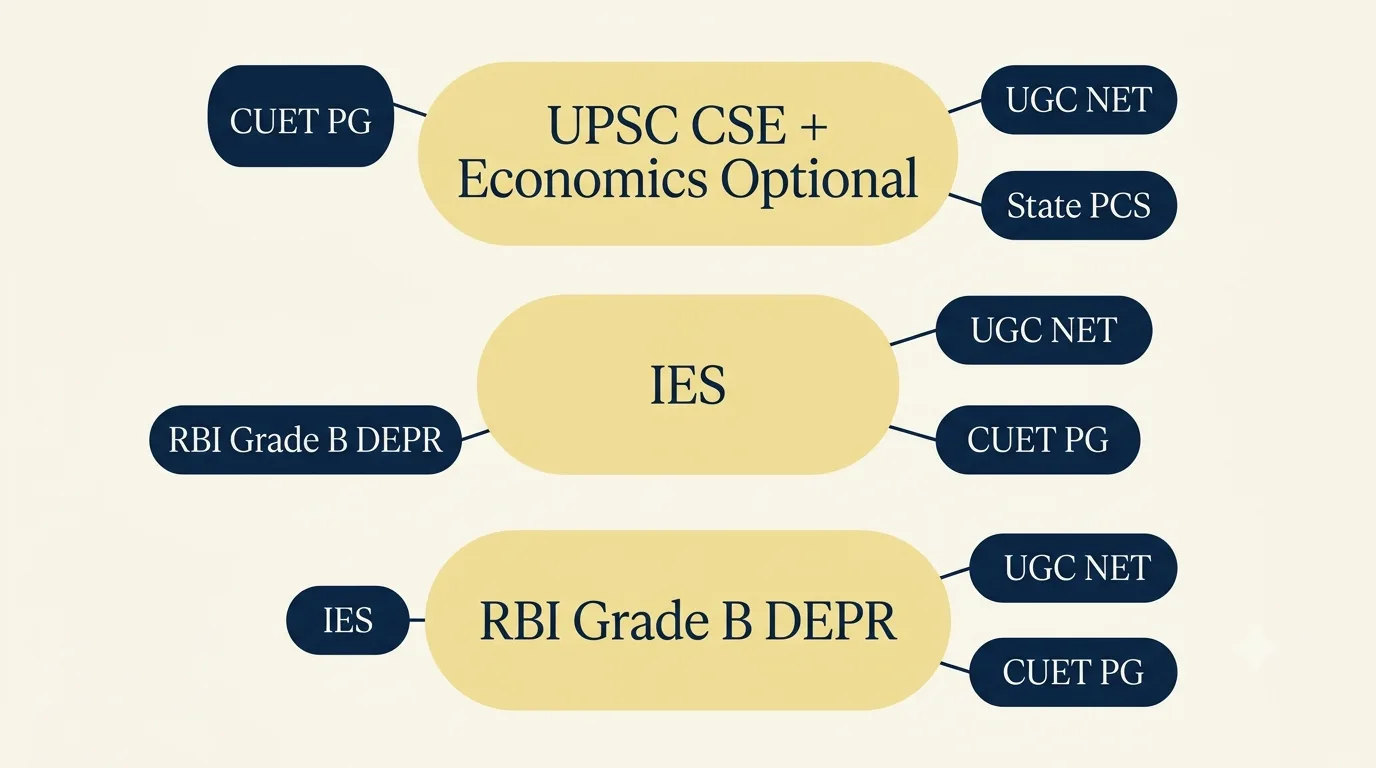
If your instinct is field administration, districts, law and order — UPSC CSE is your primary and IES is a rational backup. If your instinct is monetary policy, banking, financial markets — RBI Grade B DEPR is the closer cousin.
For how IES sits in a real backup cluster alongside UPSC CSE and RBI DEPR, see Post 3 — the backup cluster strategy.
Takeaway. IES is a hidden gem not because it is obscure, but because Economics students often forget to seriously consider it. If you are in MA Economics — or about to be — IES belongs on your list. As a primary, or as the closest backup to RBI DEPR, but on the list.
Sources and further reading
- Union Public Service Commission — upsc.gov.in: IES / ISS Notification and syllabus are the only authoritative sources for current-cycle vacancies, exam dates and syllabus.
- Ministry of Finance, Department of Economic Affairs — dea.gov.in: parent ministry of the IES cadre.
- Institute of Economic Growth, Delhi — iegindia.org: IES officer training academy and an Economics research institution in its own right.
- Economic Survey — indiabudget.gov.in/economicsurvey: annual, released before the Union Budget. Latest edition: Economic Survey 2025-26.
- Union Budget — indiabudget.gov.in: primary reference for public finance and Indian Economics current affairs. Latest edition: Union Budget 2026-27.
On EcoNiti
- Indian Economic Service exam guide — eligibility, selection, syllabus and how to begin.
- IES exam pattern and syllabus — what each paper expects.
- IES + RBI DEPR course with Dr. Komal — economics classes, tests, fees and support.