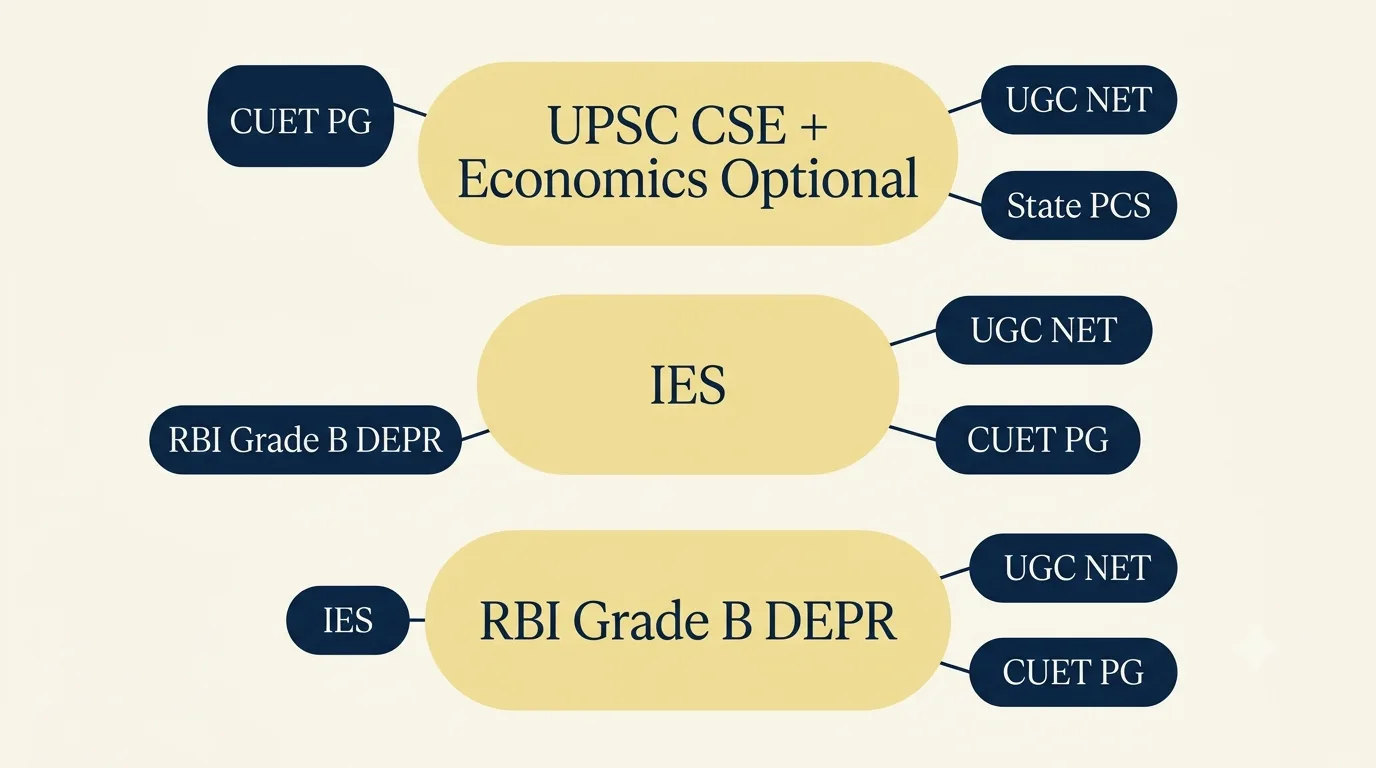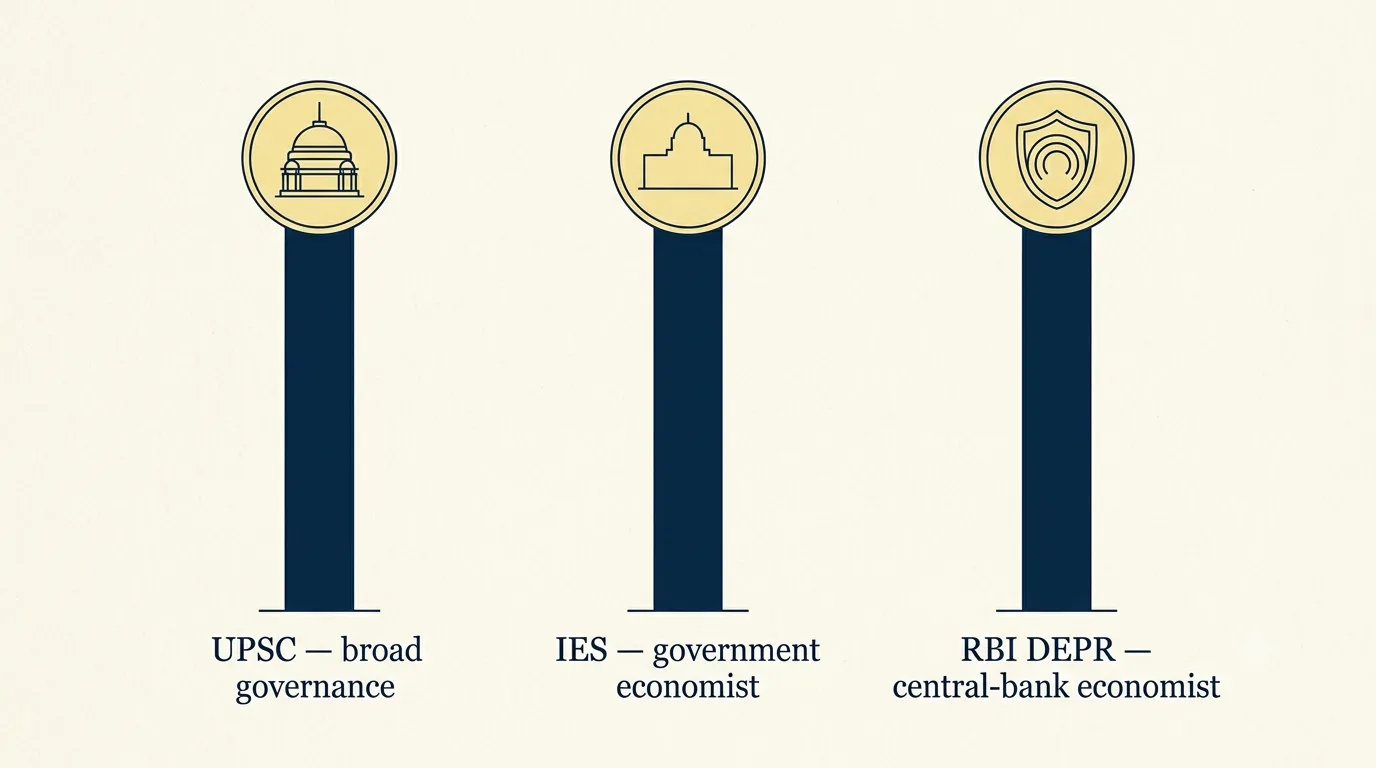
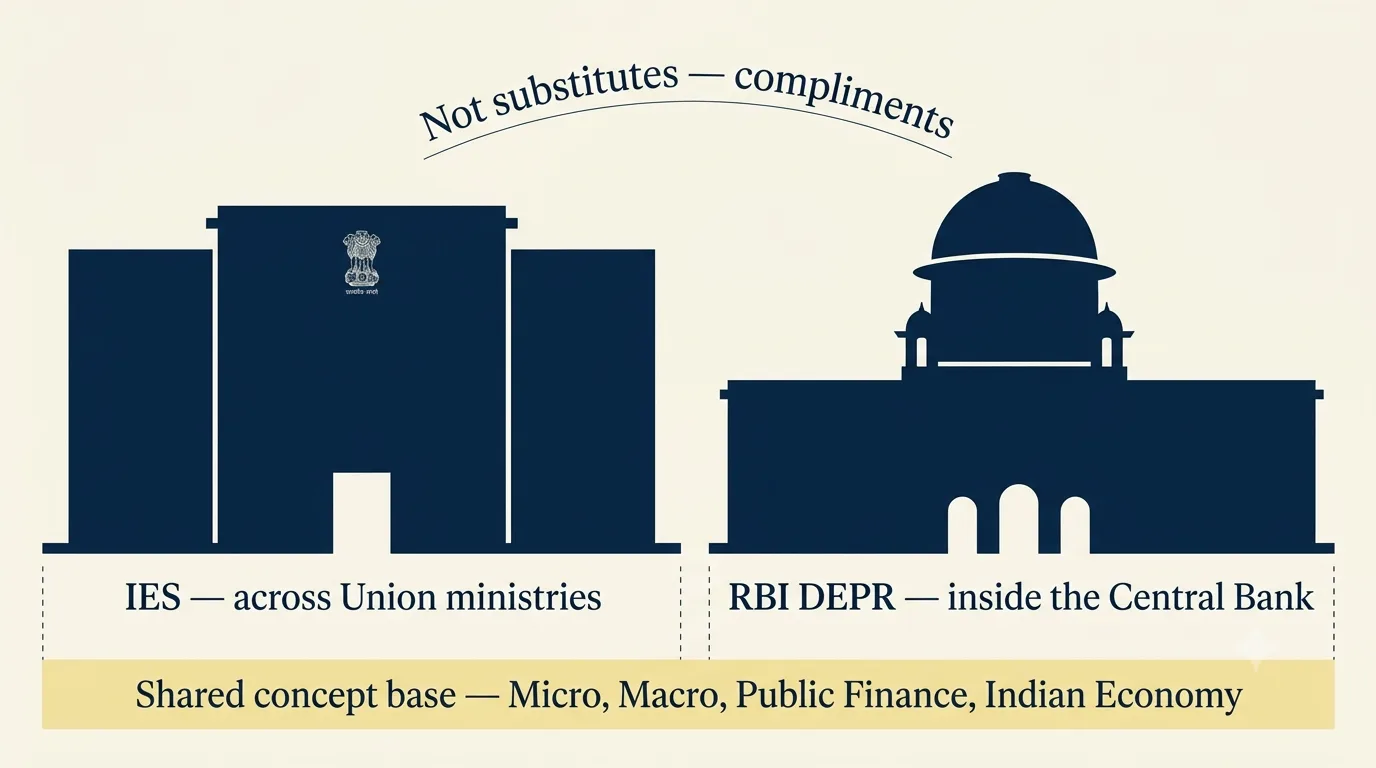
For an Economics postgraduate considering government careers, IES and RBI DEPR are natural options to compare. Much of the syllabus overlaps, so preparation for one can support the other. The jobs and exam formats differ, and those differences should guide your choice.
This post puts them side by side, applies the four-question framework to a joint strategy, and closes with four preparation principles and one timing rule that governs a two-exam calendar.
New to either exam? First read the Indian Economic Service guide and the RBI Grade B DEPR guide. Those pages explain eligibility, selection and where to begin. This article helps you compare the two.
The similarities
Worth stating clearly, since students routinely misread how much overlap really exists.
- Both are specialist Economics exams — not generalist ones.
- Both demand serious conceptual depth across Micro, Macro, Public Finance, International, Growth and Indian Economy.
- Both are heavily descriptive — you are tested on your ability to build an argument, not to recall a fact.
- Both draw candidates from the same broad pool: serious Economics postgraduates.
If you have a solid Micro–Macro–Public Finance–Indian Economy base built up for one, the other is closer to a “conversion” than a “rebuild”.
The differences
Swipe sideways to see all columns.
| Dimension | Indian Economic Service (IES) | RBI Grade B DEPR |
|---|---|---|
| Institutional scope | Government ministries and departments, with work depending on the posting | The Reserve Bank of India |
| Education | Postgraduate degree in Economics, Applied Economics, Business Economics or Econometrics | Eligible MA/MSc in Economics, Finance or specified related subjects, with subject-coverage and aggregate-marks requirements |
| Nature of the work | Fiscal policy, public finance, scheme design, development, sectoral analysis (varies by posting) | Inflation, monetary transmission, banking-sector health, financial markets, macro forecasting |
| Exam structure | Six written papers including GE I / II / III, Indian Economics, GS and English — no MCQ phase | Phase I MCQ + English descriptive, then two Phase II Economics papers, then interview |
| Career progression | Postings across ministries and departments, with opportunities for deputation to other institutions | A career primarily within RBI, with opportunities across research, policy and related departments |
| Writing practice | Six handwritten papers, three hours each | Typed English in Phase I and handwritten Economics in Phase II; two hours per paper |
The exams have different eligibility rules. Check the notification for your attempt for degree requirements, marks, age, cut-off dates and applicable relaxations.
Simple frame:
- Interest in public finance, development policy, fiscal analysis, schemes → IES is likely the better fit.
- Interest in monetary policy, banking, inflation, financial markets → RBI DEPR is likely the better fit.
- If both kinds of work interest you, the shared economics base makes them strong, complementary options. Choose one as your priority and plan the additional practice for the other.
The four-question framework, applied
1. Time available. For an MA Economics student planning 12–18 months ahead, preparing a common base and then focusing on each exam in turn is a useful approach. Start by checking your existing knowledge against both syllabi and a few PYQs. If you have much less time, prioritise one exam and use the overlap to support a second attempt where practical.
2. Backup plan. A second exam gives you another opportunity to use the same economics preparation. That is the value of this pairing: much of the study carries across, rather than requiring a second syllabus from scratch. Keep one exam as the priority and make time for the additional papers and formats of the other.
3. Interest. The clearest divider. Monetary policy, inflation, banking-sector research, financial-stability work — DEPR. Fiscal policy, scheme design, cross-ministry economic advice — IES. Answer honestly; the daily work differs sharply and both are analytically deep in their own directions.
4. Job suitability. Both roles involve analysis and writing. Compare the work you would enjoy doing, not only the syllabus you already know. Read about working in IES and the RBI DEPR career for more detail.
For the wider backup logic — including where UPSC CSE sits alongside these two — see Post 3 — the backup cluster strategy.
Four preparation principles and one timing rule
Principle 1 — Start with conceptual Economics. Do not jump straight into current affairs. Micro, Macro, Monetary, International, Public Finance, Growth, Indian Economy — concept clarity first. This is shared work between IES and DEPR; do it once, do it properly.
Principle 2 — Treat RBI’s own publications as core reading. More than newspapers. The must-read set is standard: RBI Annual Report, Monetary Policy Report, Report on Currency and Finance, Financial Stability Report and Handbook of Statistics on Indian Economy, plus the Economic Survey and Union Budget. Use the latest editions relevant to your attempt.
Principle 3 — Practise each exam’s format. Write IES answers within three-hour paper limits. For DEPR, practise objective Economics, typed English and two-hour handwritten Economics papers. Follow what each question asks instead of using the same answer length everywhere.
Principle 4 — Take English seriously. DEPR’s English descriptive paper is not a qualifying formality; treat it like a real skill exam. IES’s General English paper is also not decorative — 100 marks. Both exams punish the candidate who arrives with strong Economics and neglected English.
One timing rule — shift by phase, do not split every day equally. For an MA student with a 12–18-month preparation window, this is an illustrative plan. Adjust it to your starting level and the exam calendar:
- Months 1–6: build the shared core subjects and work through PYQs for both. Start newspapers early and keep regular time for writing and quantitative practice.
- Months 7–9: apply the core to Indian Economy, cover remaining syllabus gaps and increase timed DEPR objective practice. Continue IES General Studies and English, and practise typing answers for DEPR English.
- Months 10–12: give the nearer exam most of your mock-test and revision time. Practise its full papers while keeping the second exam’s additional requirements in view.
- After the first exam: use the available gap to focus on the next exam’s papers and answer style. If the dates are close, prepare those requirements before the first exam rather than leaving them all for the gap.
You do not need to divide every study day equally between the exams. Review your progress and the calendar, then adjust the time you give each one.
Takeaway. IES and RBI DEPR are complementary options: a shared economics base, different institutions and different daily work. If both interest you, plan for both with one as your priority. Build the common subjects once, then shift your focus by exam phase while practising each exam’s additional papers.
Sources and further reading
- RBI Opportunities: Grade B notifications, eligibility and the DEPR examination scheme.
- Reserve Bank of India, Publications — rbi.org.in: Monetary Policy Report, Financial Stability Report, Handbook of Statistics on Indian Economy.
- UPSC examination notifications: IES/ISS eligibility, papers and syllabus.
- Economic Survey — indiabudget.gov.in/economicsurvey: the latest edition relevant to your attempt.
- Union Budget — indiabudget.gov.in: the latest edition relevant to your attempt.
On EcoNiti
- RBI Grade B DEPR guide — eligibility, exam pattern and preparation options.
- Indian Economic Service guide — eligibility, all six papers and preparation options.
- IES + RBI DEPR coaching and fees — shared economics teaching and exam-specific practice with Dr. Komal. The course does not include IES General Studies, IES General English or RBI DEPR English.
Questions students ask
What is the difference between IES and RBI Grade B DEPR?
IES officers work as economists across government ministries and departments. RBI DEPR officers do economic research and policy analysis at the Reserve Bank of India. The subjects overlap, but eligibility, papers and daily work differ.
Which is easier — IES or RBI Grade B DEPR?
There is no reliable universal answer. IES has six descriptive papers and an interview. RBI DEPR has objective Economics, typed English, two descriptive Economics papers and an interview. Compare your strengths, gaps, eligibility and available preparation time rather than assuming that fewer papers means an easier exam.
Can I prepare for both IES and RBI Grade B DEPR at the same time?
Yes. The shared economics syllabus makes joint preparation worthwhile. Build the common subjects first, practise each exam's additional papers, then shift your main focus to whichever exam comes next. Choose one as your priority and adapt the plan to the actual exam dates.