If you are new to the exam, start with the RBI Grade B DEPR guide for the full form, eligibility, career and preparation options. This article explains each paper in more detail. For the work itself, read about the DEPR career and how it differs from General and DSIM.
For dates, vacancies and the eligibility cut-off for your attempt, use the notification on RBI Opportunities. This article explains the exam structure and how to prepare for it.
Eligibility and vacancies
The main eligibility requirements are summarised below. Check the notification for the exact qualifications, cut-off dates and relaxations that apply to you.
Swipe sideways to see all columns.
| Criterion | What to check |
|---|---|
| Educational qualification | Eligible MA/MSc in Economics, Finance or the specified related subjects. Check the required share of Economics or Finance courses, including electives, and the date by which the qualification must be completed. |
| Aggregate marks | Usually 55% or equivalent grade, with a lower threshold for eligible reserved categories as specified in the notification. |
| Age | Usually at least 21 and under 30 on the date specified in the notification, before applicable category, qualification and experience-related relaxations. |
| DEPR vacancies | Announced separately for each recruitment cycle; check the DEPR and category-wise split. |
| Recruiting body | Reserve Bank of India |
For BA Economics and current MA students: a BA alone does not qualify, but you can begin preparing while studying for an eligible postgraduate degree. To apply, you must complete the required qualification by the notification’s cut-off date. Check your exact degree and subject coverage against the eligibility list.
DEPR has limited seats and a specialist applicant pool. For an Economics postgraduate, its appeal is that the examination builds directly on your subject knowledge. Compare the syllabus with what you have already studied, then plan for the remaining topics and exam practice.
The three-stage exam pattern
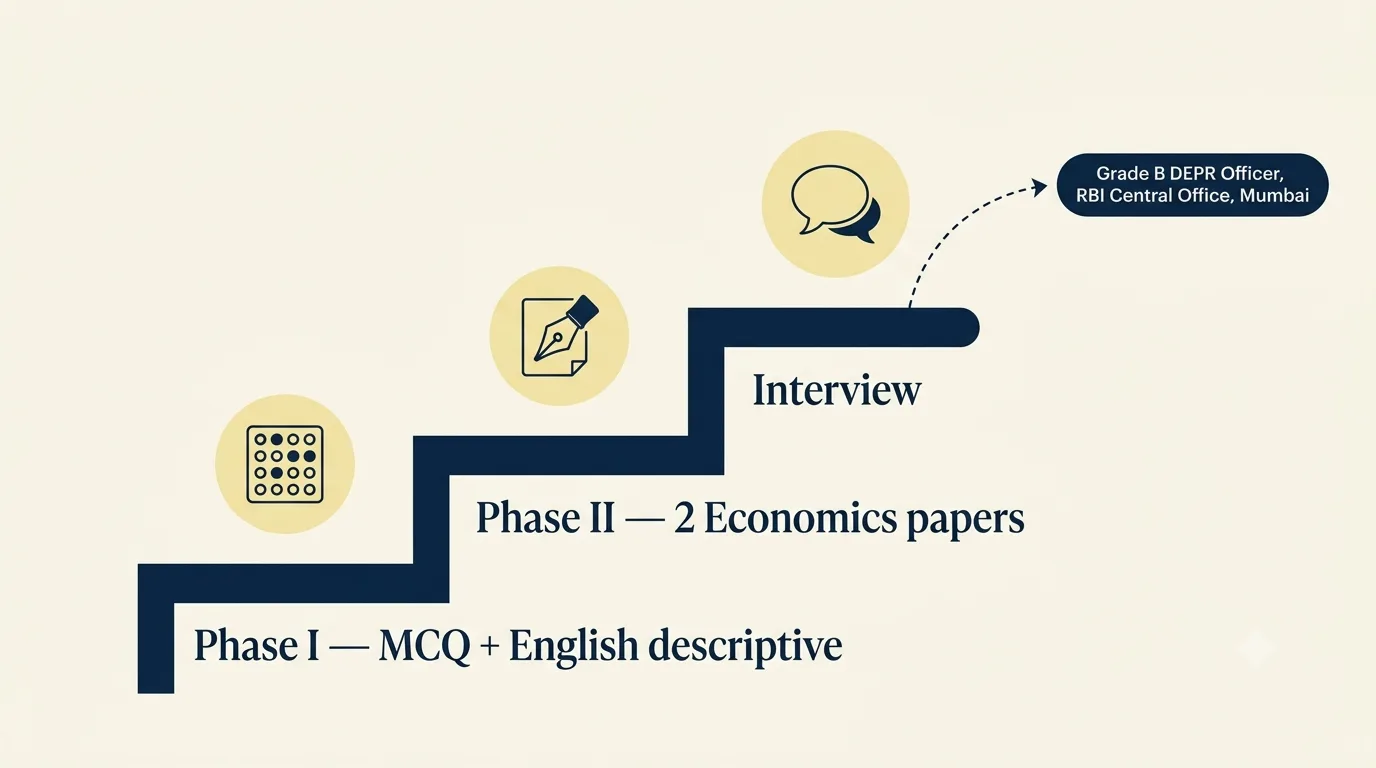
Three stages: Phase I → Phase II → Interview.
Swipe sideways to see all columns.
| Stage | Paper and format | Marks | Time |
|---|---|---|---|
| Phase I | Paper I — Economics, objective | 100 | 120 minutes |
| Phase I | Paper II — English, descriptive answers typed on a computer | 100 | 120 minutes |
| Phase II | Paper I — Microeconomics + Macroeconomics, handwritten descriptive answers | 100 | 120 minutes |
| Phase II | Paper II — Quantitative Methods + Indian Economy, handwritten descriptive answers | 100 | 120 minutes |
| Interview | Interview after written shortlisting | 75 | As arranged by RBI |
The written papers total 400 marks. Both Phase I papers, both Phase II papers and the interview count towards final selection: 475 marks in all. Phase I is not merely qualifying. RBI sets the shortlisting cut-offs, and the separate personality assessment carries no marks.
For Phase II, questions are displayed on a computer but answers are written on paper. You may write the Economics answers in Hindi or English; the Phase I English paper must be answered in English. The interview may also be taken in Hindi or English.
Two things worth calling out.
The English descriptive paper is not a formality. It contributes to shortlisting and final selection. Practise clear, organised writing on a keyboard as well as handwritten Economics answers. Check the exam handout for the detailed English-paper instructions.
DEPR is narrower than General at Phase II — by design. The General stream has three Phase II papers including Finance and Management. DEPR has two papers, both pure Economics. That narrowing is not a shortcut; it is the exam’s way of asking for depth in fewer areas. Prepare accordingly.
If I had to summarise DEPR’s philosophy in one line: can you think like an economist, and can you communicate like one? Phase I tests speed of recognition. Phase II tests structured written argument. Interview tests judgement.
Syllabus — the actual structure
Phase I (objective) is the wide net. Eight areas — Microeconomics, Macroeconomics, International Economics, Theories of Growth and Development, Public Finance, Environmental Economics, Quantitative Methods, and Current Developments in the Indian Economy. Breadth — can you recognise and place concepts across the whole subject, quickly and accurately? Timing is decisive here; you do not get to think slowly.
Phase II is where the real structure shows up: two papers, each with two equally-weighted modules.
Phase II Paper 1 — Microeconomics and Macroeconomics (equal weight)
- Micro: consumer theory, production theory, market structures, distribution theories (Ricardo, Marx, Kalecki, Kaldor), welfare economics (Pareto, Arrow, Coase, Sen).
- Macro: national income accounting, employment and output from Classical to Post-Keynesian, inflation (Phillips Curve, Taylor Rule), money and banking, monetary policy, growth and development theory, international trade, balance of payments and public finance.
For an MA Economics graduate, Micro is largely a rigour check — the distribution and welfare theorists are where most candidates need a specific pass. Macro is closer to what you have used in college, but the monetary transmission and Taylor-rule questions expect precise formulation.
Phase II Paper 2 — Quantitative Methods and Indian Economy (equal weight)
- Quant Methods: calculus, optimisation, sets, matrices, linear algebra, linear programming, statistics, index numbers and econometrics. Econometrics includes regression, time series, panel data, Bayesian basics and basic applications of AI and machine learning.
- Indian Economy, Policy and Trends: fiscal policy, monetary policy and the RBI’s own functioning, banking and financial-sector developments, inflation trends, external sector, and sectoral developments across agriculture, industry and services.
The Indian Economy module is where RBI’s own publications become required reading — not because they are compulsory in the syllabus, but because they are the vocabulary you are expected to already be using. The Monetary Policy Report, Financial Stability Report, and Report on Currency and Finance are your best sources for the “current” flavour the exam expects.
Build the core theory first, then use it to understand Indian economic issues. Start reading newspapers early, and make time for quantitative practice throughout. When planning revision, remember the paper weights: Microeconomics and Macroeconomics have equal weight within Phase II Paper I; Quantitative Methods and Indian Economy have equal weight within Phase II Paper II.
Takeaway. DEPR’s structure funnels candidates through breadth (Phase I MCQ) into depth (two Phase II descriptive Economics papers) into judgement (interview). The design is honest: it selects for economists who can think and write. Prepare in that order — breadth for pattern recognition, then depth in Micro + Macro + Quant + Indian Economy, then simulated interviews once shortlisting is realistic.
Sources and further reading
- RBI Opportunities: Grade B recruitment notifications, eligibility, exam scheme and DEPR syllabus. Read the notice for your attempt.
- Reserve Bank of India, Publications — rbi.org.in: Annual Report, Monetary Policy Report, Financial Stability Report, Report on Currency and Finance, Handbook of Statistics on Indian Economy.
- Economic Survey — indiabudget.gov.in/economicsurvey: use the latest edition relevant to your attempt for Indian Economy preparation.
- Union Budget — indiabudget.gov.in: use the latest relevant Budget for fiscal policy and spending priorities.
On EcoNiti
- RBI Grade B DEPR guide — eligibility, career and a starting plan.
- Free RBI DEPR resources — syllabus and reference material.
- IES + RBI DEPR coaching with Dr. Komal — economics classes, tests, evaluation and fees. The separate English paper is not included.
You do not need to enrol to use the free resources. If you need classes but the fee is a concern, ask us about the Scholars Programme before deciding against applying.